
I GO! | Edition 11 — Samarkand, The Marvels of the Silk Road and Understanding the World with Your Soul
This Week: Samarkand — Tashkent
05/04/2025
“Traveling – it leaves you speechless, then turns you into a storyteller.” — Ibn Battuta
Assalomu alaykum! This week in I GO! — I write to you on my way back from Uzbekistan, the beating heart of the ancient Silk Road, the most populated country in Central Asia, double landlocked and … the stuff of fairy tales. And where do I start…. I loved EVERY SINGLE MINUTE OF THAT TRIP (other than the traffic in Tashkent. And the hair-raising driving…).
Walking on a Dream
My third time in Uzbekistan, but the minute I landed, it felt like the first time, with everything to discover again, and I stepped into an endless, timeless, delectable reverie.
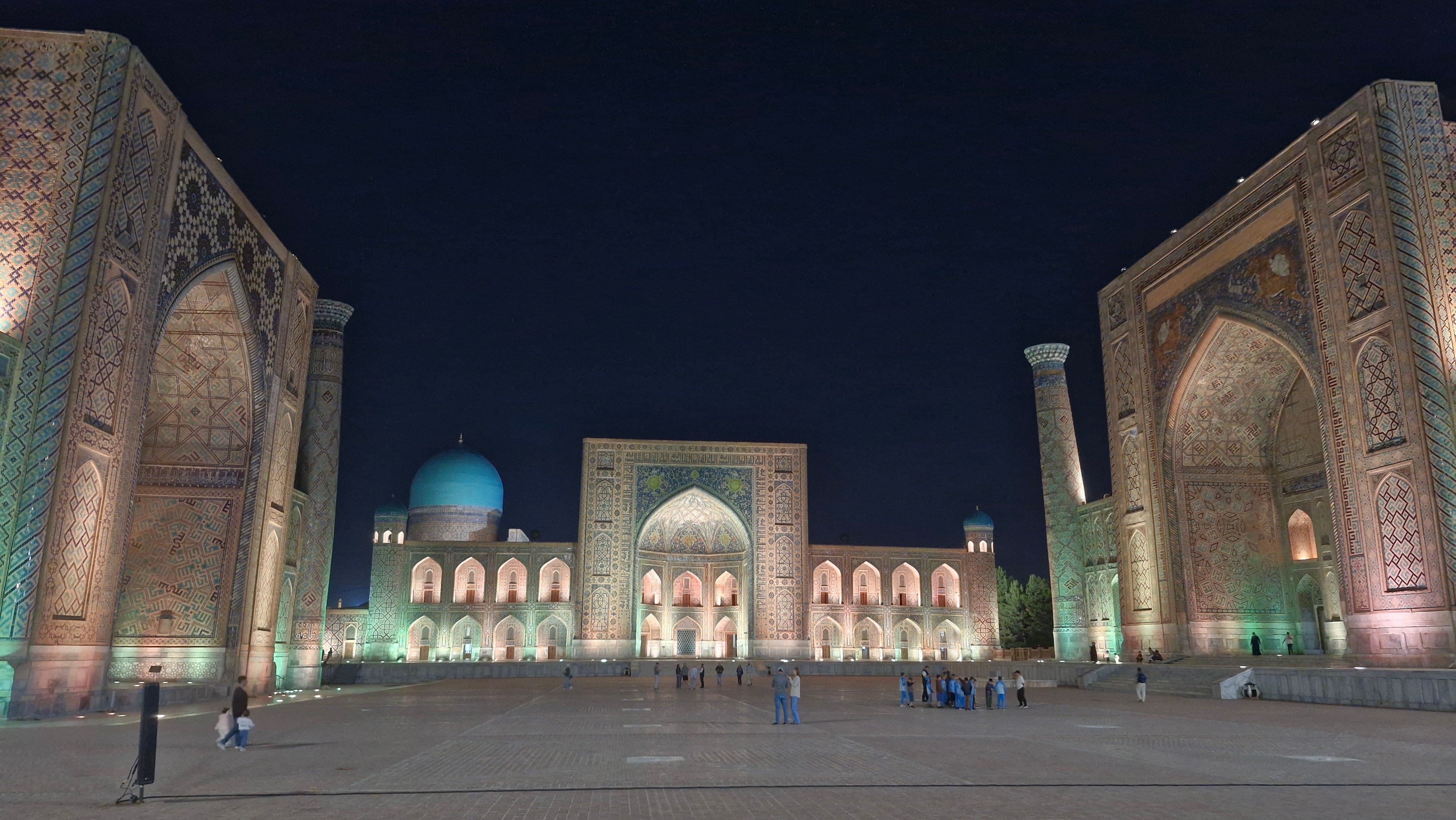
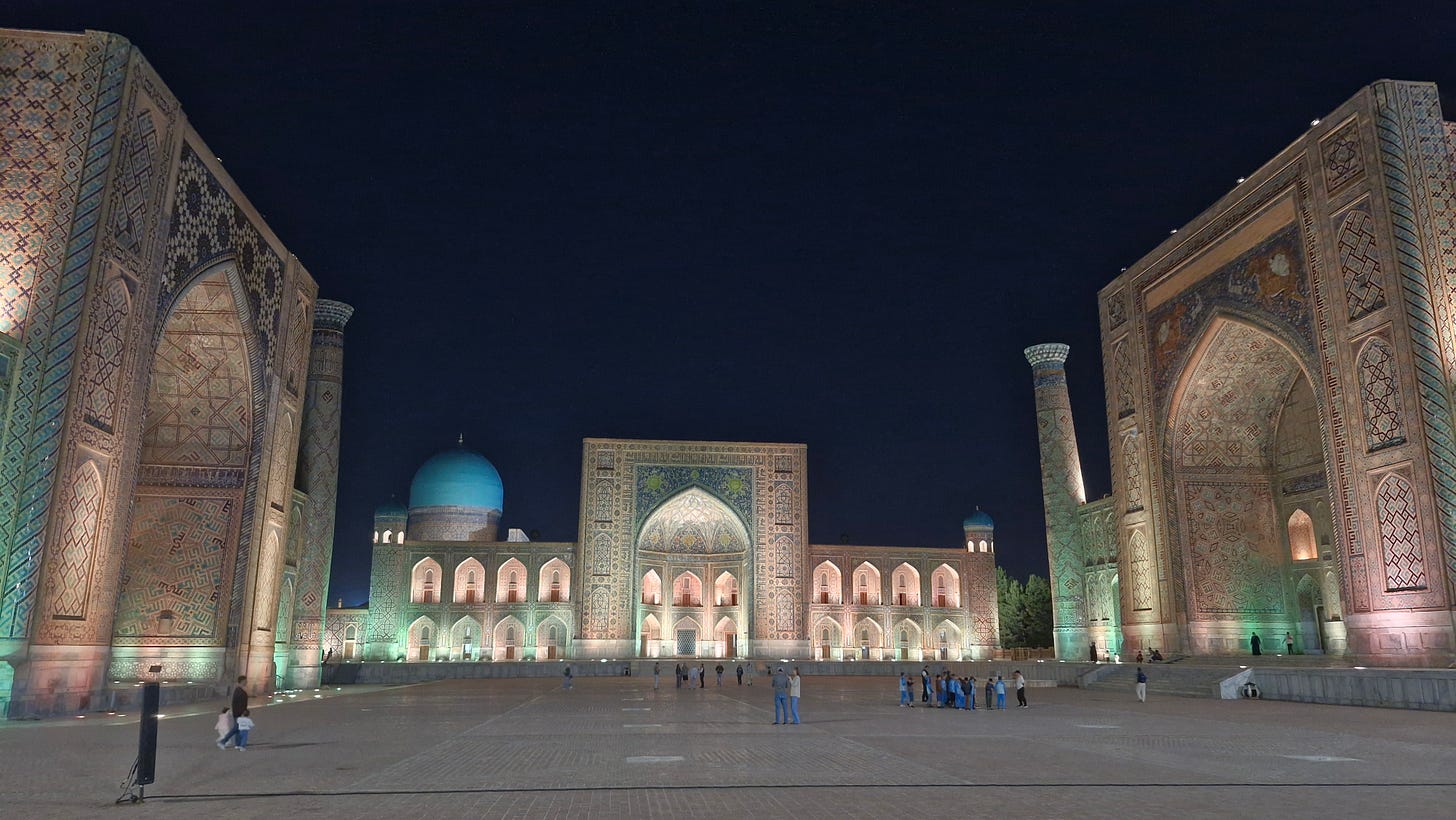
Here, in cities like Samarkand and Tashkent, once crossed by caravans of merchants, mystics, dreamers and scholars, the echoes of empires, conquests and bloody victories still linger. It is in the diverse faces and skin colours of the people, the languages they speak, the food they eat. It breezes through the arches of the Registan, the tilework of Ulugh Beg’s madrasah, the turquoise domes of the Shah-i-Zinda mosques and mausoleums that seem to want to push the sky itself.
Uzbekistan stirs me, appeals to my Romanesque soul, my unquenchable thirst for discovery.
As a child, I read, captivated, One Thousand and One Nights –by Antoine Galland (the French translation is the first European version of Arabian Nights), every night looking forward to a new chapter of Scheherazade’s tales, Aladdin’s legendary luck and Sinbad’s supernatural exploits.
Improbable, and often slightly sarcastic, stories of jinns, ghouls, of souks of gold and silk, of tyrannical kings and mean viziers, rose-scented courtesans, exquisite fabrics and poetry, harems of forbidden deeds, and endless, vast, clear night skies adorned with golden moon crescents.
Me, in my cold, cloudy Breton peninsula, continental France’s westernmost region - the rain outside, small bedside lamp and itchy blanket, dreaming of the ancient marvels and legends of The Far East. And then, one day, as a woman…Samarkand!!!
Its main sites, the Registan, Gur-e-Amir, Shah-i-Zinda —not just architectural marvels, but acts of devotion, of power, of worshipping all the gods and prophets behind the Creation. Ahura Mazdā and Zarathustra, Zeus, Moses, Buddha, Vishnu, Jesus and Mohammed… Iranians, Achaemenids, Sogdians, Timurids, Soviets…Shias, Russians, Ukrainians, Belarusians, Armenians, Azeris, Greeks, Tajiks, Kirgiz, Bukharan Jews, Tatars, Koreans, Poles, and Germans…Markanda!
Minarets, madrassas and dusty courtyards. Warm, rough, bricks and polished blue tiles - time suspended. The beauty that makes you weep.
Ah blue…. Turkic peoples’ colour. The skies above the steppe, precious water, wealth. Warding off the evil eye.
"Samarkand is one of the greatest and finest of cities, and most perfect of them in beauty." Ibn Battuta, 1333.
At its height, Samarkand was a crucible of civilisations — Persian, Greek, Turkic, Mongol, Arab. A prime world centre of science, poetry, astronomy, and theology. Timur made it the capital of his empire and filled it with artisans and architects from across the known world. His grandson, Ulugh Beg, turned it into one of the great intellectual hubs of the Islamic Golden Age.
Breathtaking Registan Square, with its three majestic madrasahs adorned with intricate mosaics and calligraphy, was once a vibrant centre of learning and debate. Under Ulugh Beg’s patronage, scholars gathered here to study the stars, geometry, and philosophy.
I had a moment of intense presence at the necropolis of Shah-i-Zinda, the “Living King,” a procession of mausoleums cascading up a hillside, adorned in every imaginable shade of turquoise and lapis, glazed tile and majolica. Legend has it that it holds the tomb of Qutham ibn Abbas — cousin of the Prophet Muhammad. Walking through its arched passageways feels like entering a sacred dream…
There I felt it.
A quiet explosion of awe, heavy humbling - at genius, hand of Man,
Tingling tears of elation,
A return to the All, the Universe, the miracle of being here,
Alive, awake, and able to witness such splendour.
“I set out… swayed by an overmastering impulse not just to see, but to feel.”
Like Ibn Buttuta, I have a compulsion, an overwhelming impulse: Make sense of this world, not only reason, but with the senses, the soul.
Here, in this ancient city of mosaics and minarets, I felt it again — the sheer joy of just…being. The clarity of a quietened mind. The peace flooding in when opening fully to beauty, discovery, colours, smells, sounds, textures, the flow of life.
Bustling, cosmopolitan, energetic Tashkent
In Tashkent, a complete change of atmosphere, the lively, loud, polluted, elating bustle of a large and dynamic capital. And a wander through the Old City.
Here, amid old and new mosques, and narrow streets, stands one of Islam’s most sacred treasures: the oldest known copy of the Quran, a 7th-century manuscript believed to have belonged to Caliph Uthman. Delicate Kufic script inked on ancient parchment.
Then, in stark sensory contrast, the buzz and colour of Chorsu Bazaar (Ashok Market). A feast for the senses: mountains of spices, pyramids of fresh fruit, sacksful of nuts, pickled vegetables, freshly baked breads, shouting vendors, the scent of samsa wafting through the air, the heat of the fire ovens.
The place hums with life, texture, flavour. It’s not just a market — it’s a living mosaic of Tashkent and Uzbekistan’s soul.
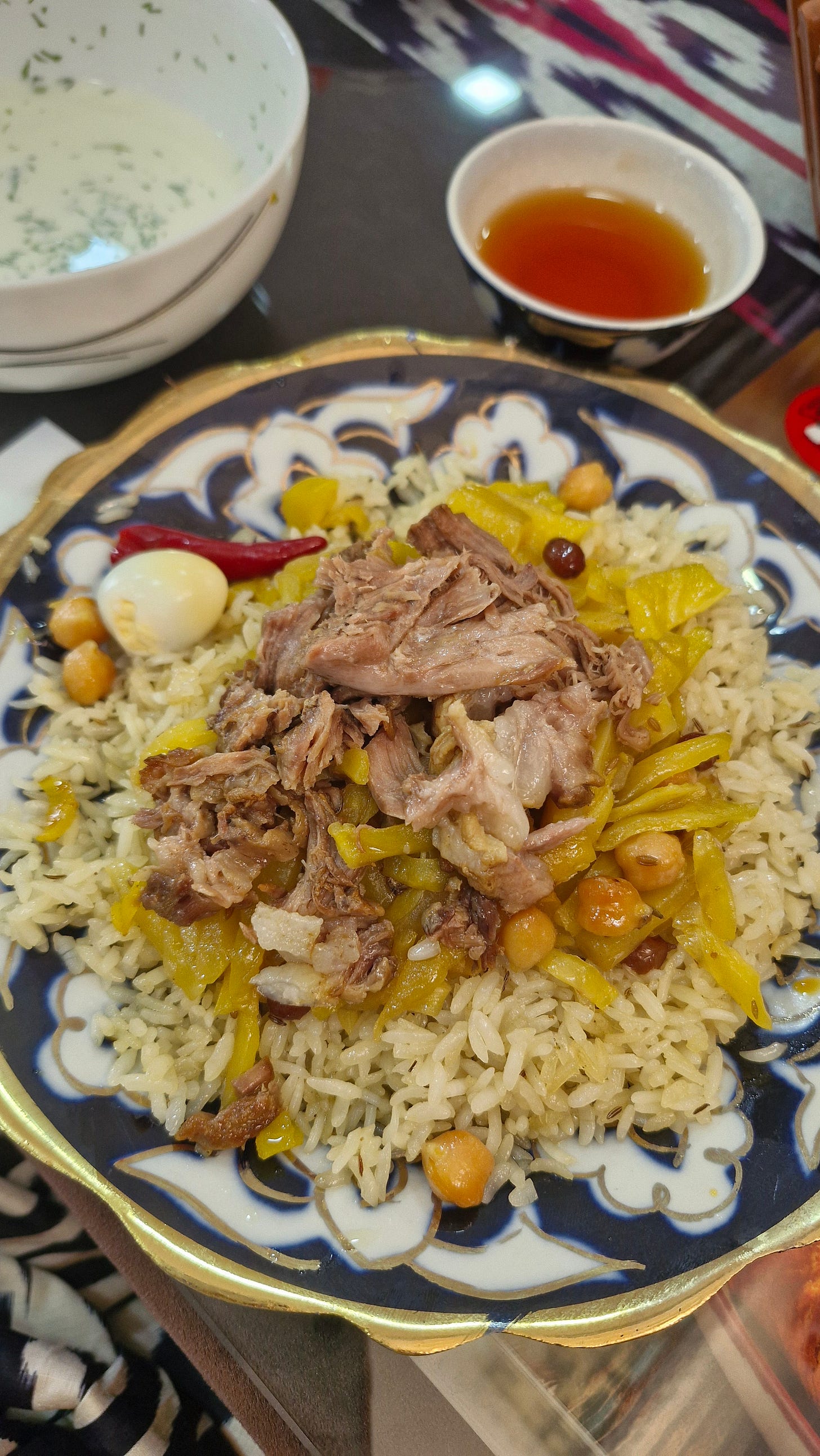
As always, this trip was the opportunity to experience the legendary warmth of Uzbek hospitality. A generosity expressed in both spirit and cuisine — one dish after another, shared with laughter and pride. The kindness of strangers - shy smile first, shiny eyes of curiosity, hand on the heart. Honest, simple, wholesome, positive.
At trendy Tandiriy, the solar Malika Sharipova, met at the Uzbekistan Economic Forum a couple of years back, and I, enjoyed the modern take on Uzbek dishes and fun interpretations, with traditional wooden instruments, of Dr Dre and Michael Jackson hits (What?), in the Insta-friendly, earthly, uterine décor. Old and New.
I also indulged in a little local fashion… Ikat suits and the softest cashmere throws I picked up along the way — how could I resist?
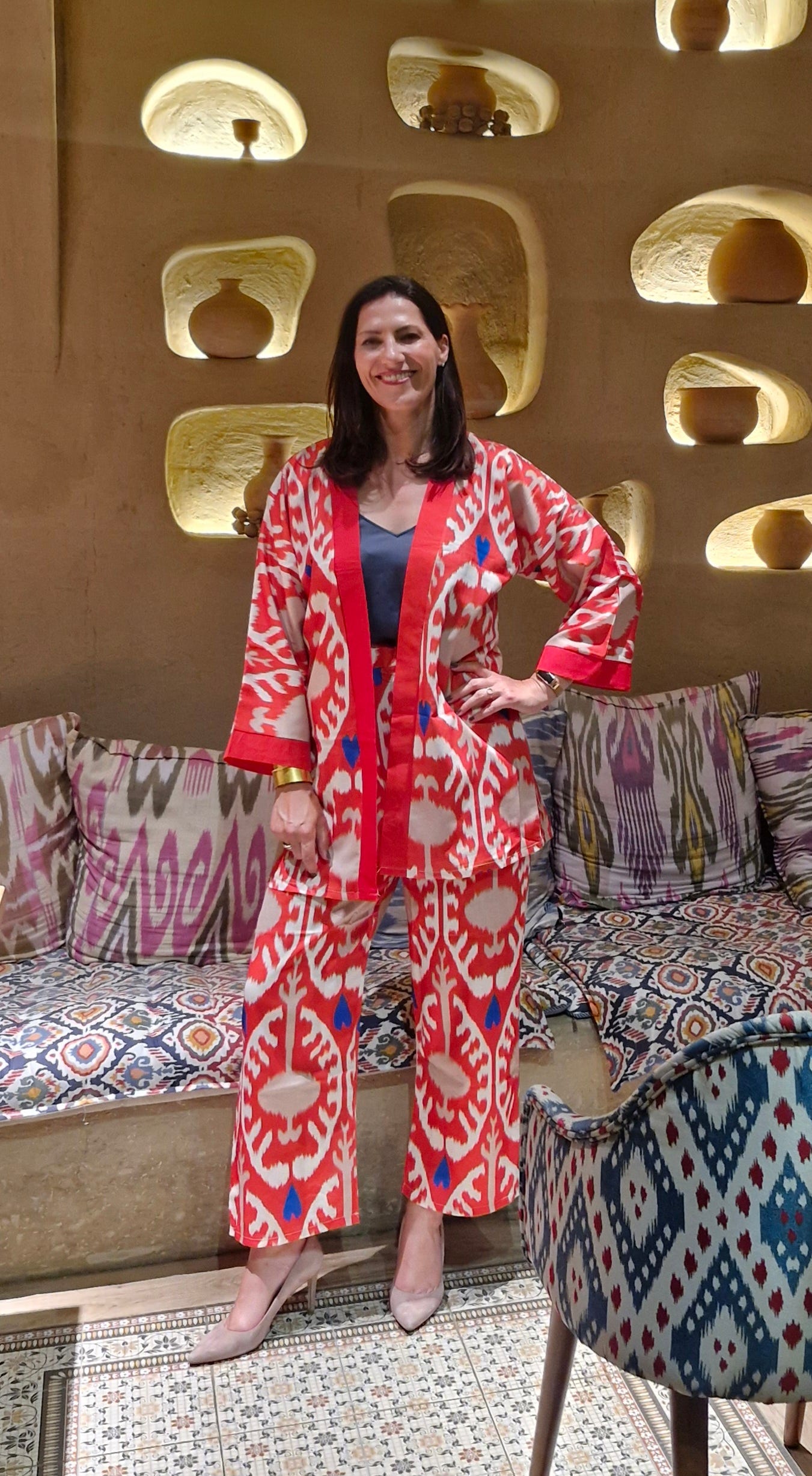
The ikat — with its vibrant, hand-dyed geometric patterns, the fruit of centuries-old techniques, known locally as abr, creating a blurred motif, is one of the country’s most iconic exports. Uzbekistan is one of the world’s top ten producers of cotton (studies rank the country between 6th and 8th globally), and silk production, deeply rooted in the region’s Silk Road legacy, is still thriving (Uzbekistan ranks 3rd globally in silk production, after China and India). Fergana Valley’s silk is prized for its richness and texture — and ikat cloaks, scarves, and jackets are impossible to resist. I certainly can’t…
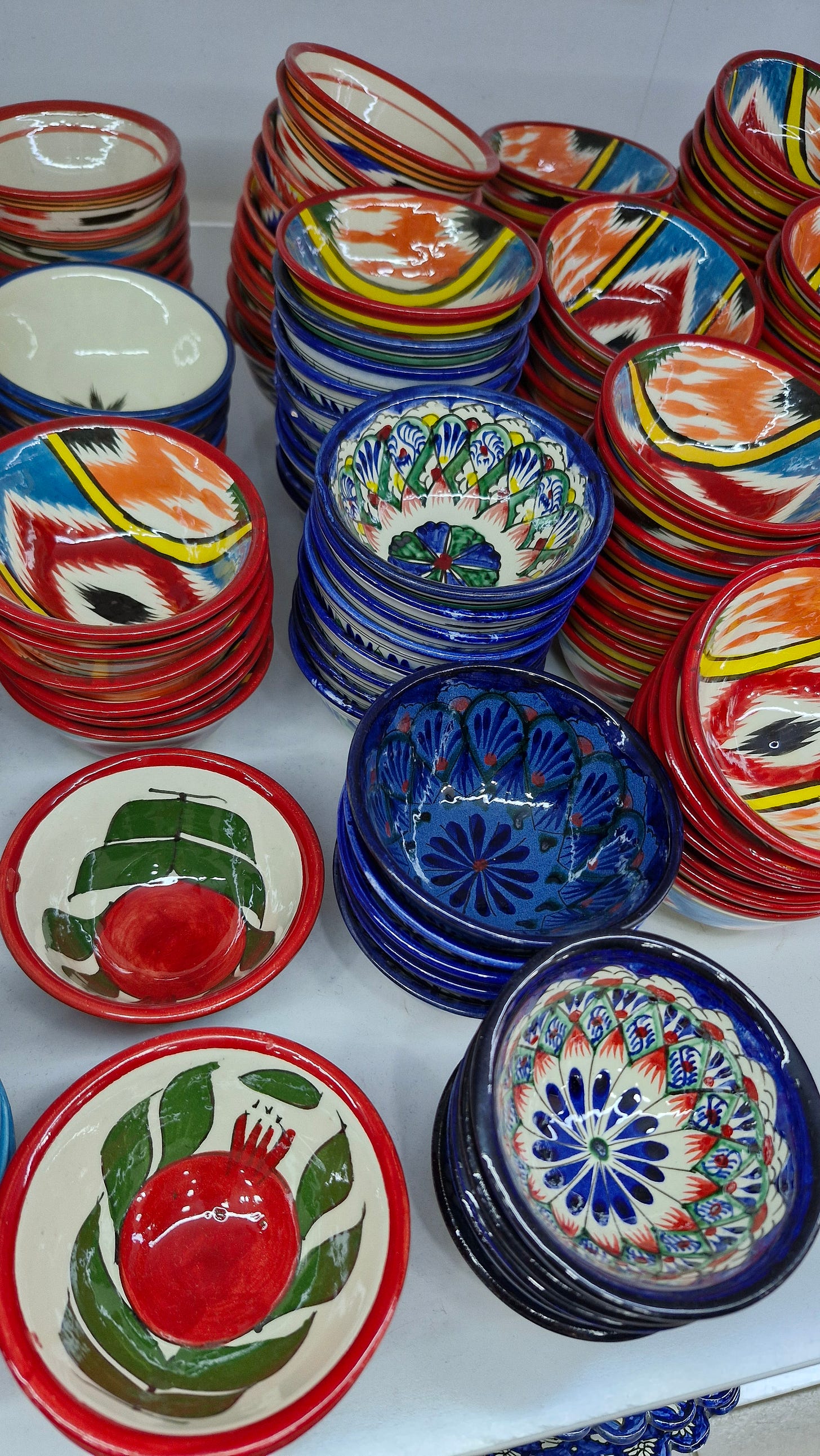
And then there’s the pottery — from the blue-glazed ceramics of Rishtan to the earthy, hand-painted designs found in local bazaars. There’s so much more to Uzbekistan craftsmanship - embroidery, hand-woven rugs, woodwork etc…
Cosmic Soviet Creations: Russian Modernism icons
In Tashkent, also admired a few cosmic surprises —Soviet utopianism in marble, glass, and concrete. There is a abundance of modernist and brutalist soviet-era architecture in the capital. The Kosmonavtlar metro station (yes, that's Cosmonauts) is a celestial homage to the Soviet space age.
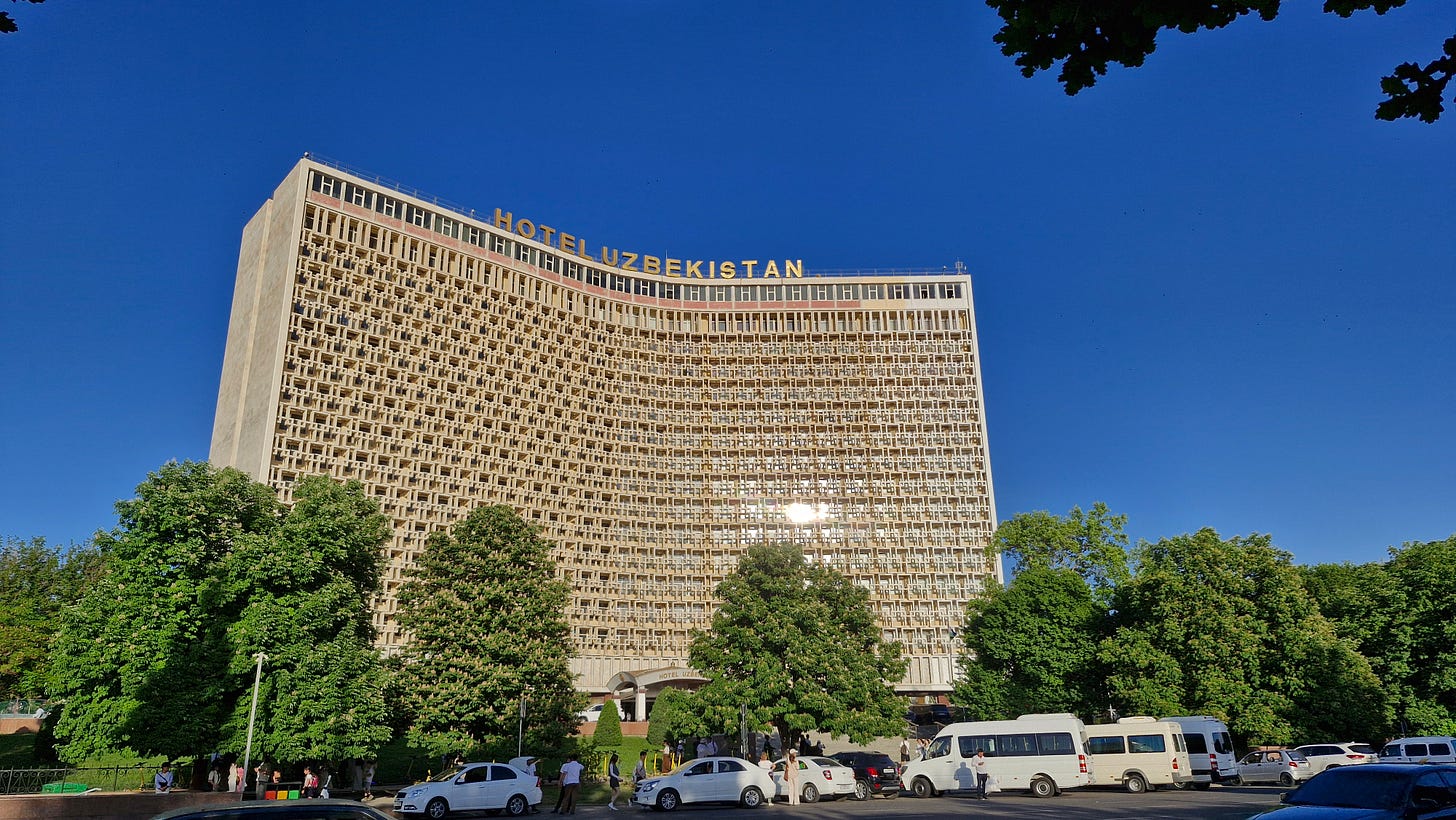
Hotel Uzbekistan is THE capital’s brutalist icon with its stern lattice façade. Alongside other masterpieces of these structures add yet another layer to the capital’s rich architectural collage — Central Asian, Islamic, Tsarist, Soviet, and now global.
"I set out alone, having neither fellow-traveller in whose companionship I might find cheer, nor caravan whose part I might join, but swayed by an overmastering impulse within me and a desire long-cherished in my bosom to visit these illustrious sanctuaries. "
A metaphor for how I GO! about life, by Ibn Battuta, again, insatiable explorer who saw more of the world than Marco Polo, treating existence like a never-ending journey, alone but complete in search of…the Absolute?
And you know what? The Silk Road never even existed.
It is a construct, a concept, the invention of a romantic European - 19th-century German geographer and novelist Ferdinand von Richthofen reportedly. Yes, there were many trade routes linking East and West, and caravans carrying fine fabrics, spices and exotic treats, but not a slow medieval desert superhighway known by that name. Does it even matter? He too wanted to be transported. So, come. Come wander with me…Until next week, and a caravans’ end point, with a full heart of love and gratitude. Charlotte
Subscribe to get new posts
Peakub is a home for creators, publishers, and teams to publish, grow, and monetize their work — all in one place. We're building a fast, privacy‑respecting platform that helps you focus on your craft while Peakub handles the plumbing — from content tooling to delivery and analytics.

I GO! by Charlotte Kan




Comments