
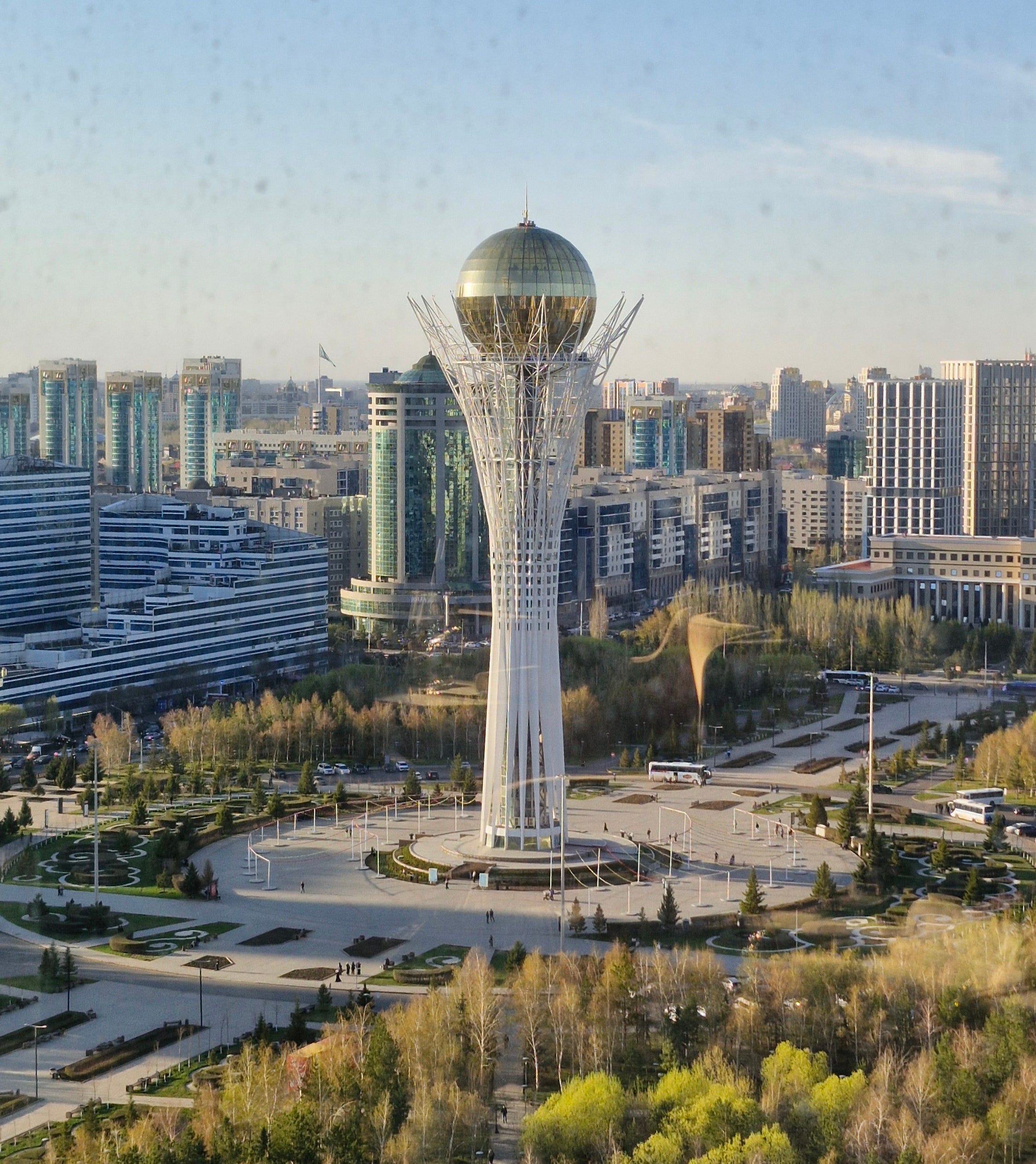
I GO! Edition 44 - Kazakhstan, the Beating Heart of Eurasia’s Nomadic Culture
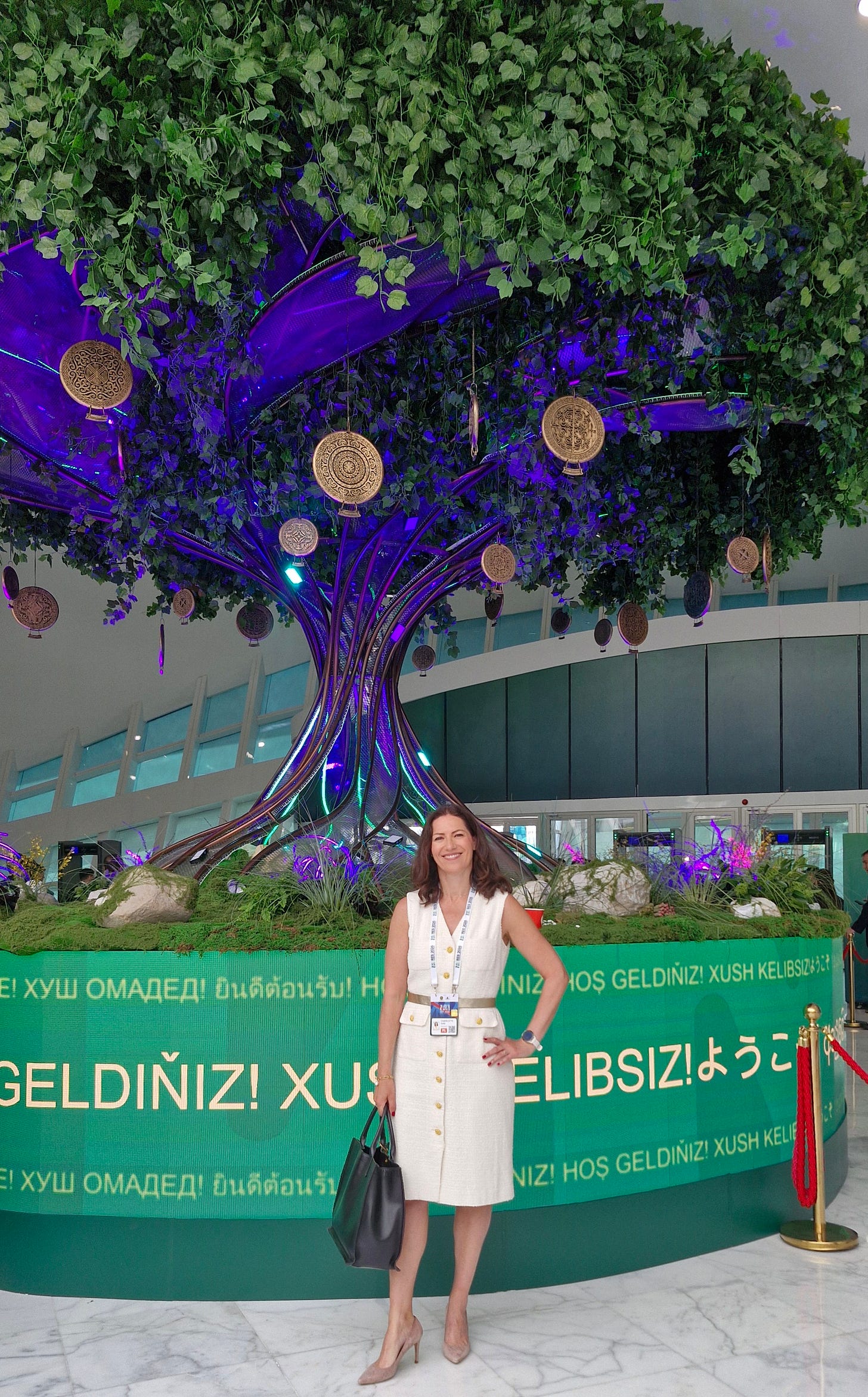
Just back from Astana's Regional Ecological Summit. Was it my 6th or 7th visit? Does it matter? Each time it feels different. Each time I learn, and realise how little I know. Each time, it is a joy.
04/28/2026
Yes, each time I land in Astana, this futuristic city rising improbably from the steppe, or in Almaty, cradled like a jewel, an emerald, by the Tian Shan mountains, something in me opens.
A sense of unabashed freedom.
Of possibility.
Of myth.
It is the sheer vastness and mystery of this land, still largely unknown to many Westerners, it does something to the imagination. Mine begins to gallop, untethered, like a steppe horse. I find myself dreaming of surrendering to it entirely - riding across open plains, through mountains and deserts, hair in the wind, carried by nothing but instinct, trust, and the thrill of discovery. No wonder: the word “Kazakh” is thought to derive from the ancient Turkic qaz - to wander.
A country for wanderers. Free spirits. Those drawn to liminality.
Kazakhstan may be the size of Western Europe - larger than the UK, France, Germany, Spain, Sweden, Norway, and Finland combined - yet with a population of just ~20 million, it remains one of the most sparsely populated large countries in the world.
For romantic souls, it offers something both precious and somewhat dangerous for vagabond minds: a true frontier of imagination. A portal.
A place where space is not just geography - but stories.
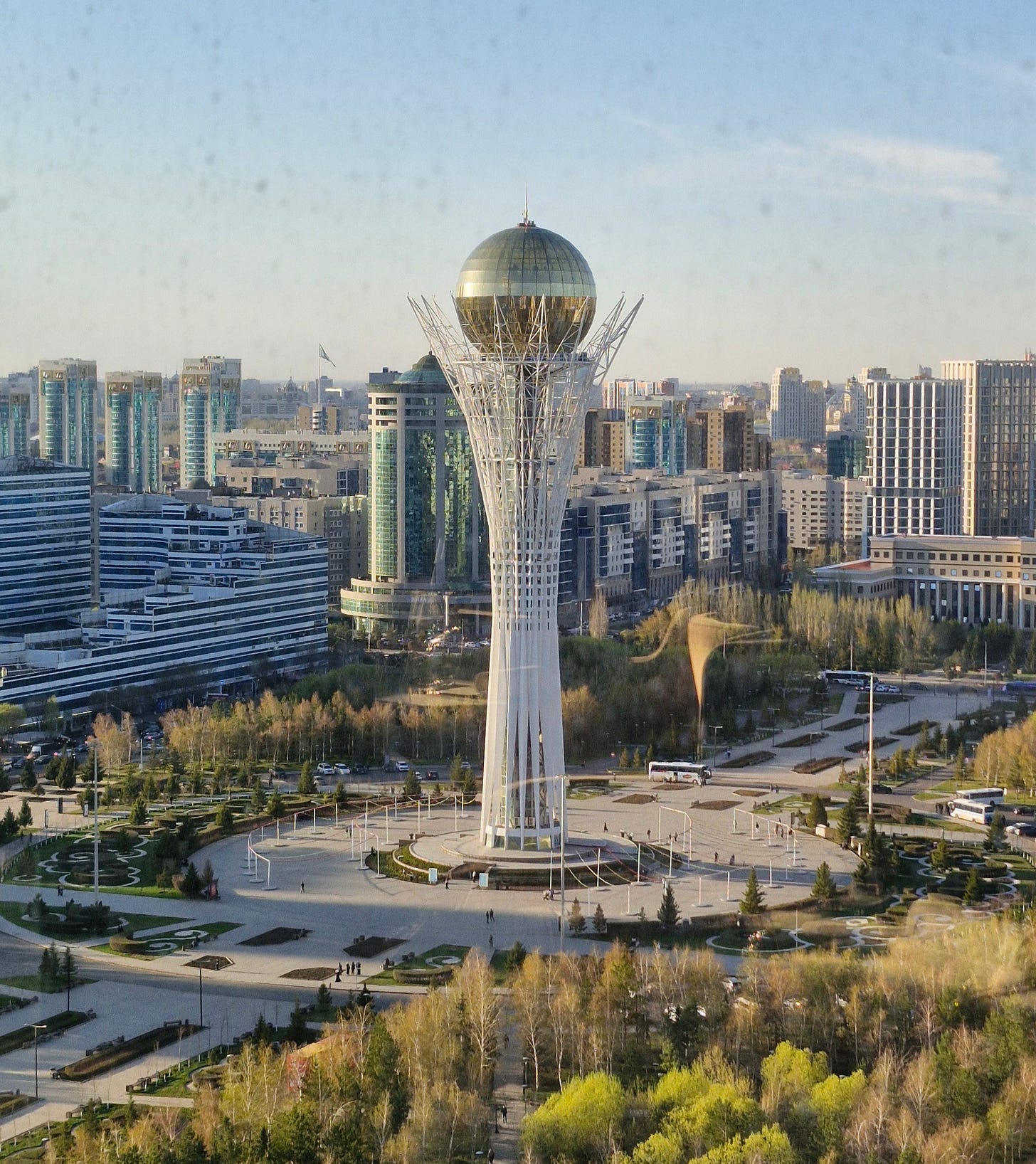
Shanyrak: Life, Eternity, and Prosperity
Kazakhstan’s DNA is nomadic. For over three millennia, the Eurasian steppe was home to mobile civilisations - Scythians, Saka, Turkic tribes - who moved with the seasons, following pasture and water. At their peak, nomadic empires controlled vast transcontinental routes, including early arteries of what would become the Silk Roads.
Mobility here was survival but also power. And everything still flows from that.
In psychogeography, they’d say movement shapes worldview just as much as rootedness: adaptability, resilience, but also community. You move, but never alone.
Kazakhstan today is home to over 130 ethnic groups, a legacy of migration, empire, and Soviet-era population movements, but I also perceive a deeper, older openness and curiosity embedded in nomadic culture.
What struck me most, when I first visited the country nearly a decade ago, was the faces. Despite living in London - one of the most diverse cities in the world - I had rarely seen such a thing as the eclectism of Eurasian features: high cheekbones, elongated eyes, sometimes green or violet, silky hair, lighter undertones, flat or aquiline noses, so many skin shades. A living crossroads. History etched on people’s faces and skin.
Hospitality as Civilisation
What also struck me, like in neighbouring Uzbekistan, is the Kazakh generosity. Here, hospitality is not a gesture, a courtesy or a transaction. It’s more than a love language, it is unconscious, embedded in the fabric of society.
Historically, on the steppe, refusing a traveller food or shelter could be a matter of life and death. So generosity became law, then culture - then instinct.
Tables overflow with abundance - flowers, textures, colours, histories: baursak, those golden clouds of fried dough; many types of horse meat, central to tradition; mountains of dried fruits and nuts; kurt, that ancient cured dairy - sharp, dense, earthy, almost … elemental.
Kazakhstani desserts are rich, sweet, and served with tea - zhent, a no-bake millet dessert; shak-shak, fried dough bound in honey; balkaymak, indulgent honeyed cream.
Not just treats - but rituals of welcome and celebrations for special holidays.
Meals stretch. Time dilates. You are invited not just to eat, but to be present. To talk. To connect. To relax. There is something almost “Arabian Nights” about it - a sense of opulence, yes, but also storytelling, continuity, and ritual, because its dish carries memory.
You are not just fed: you are … received.
Of Horses, Felt, and Symbols
The horse was first domesticated on the Eurasian steppe - archaeological evidence from northern Kazakhstan (Botai culture, ~3500 BCE) suggests some of the earliest horse domestication in human history.
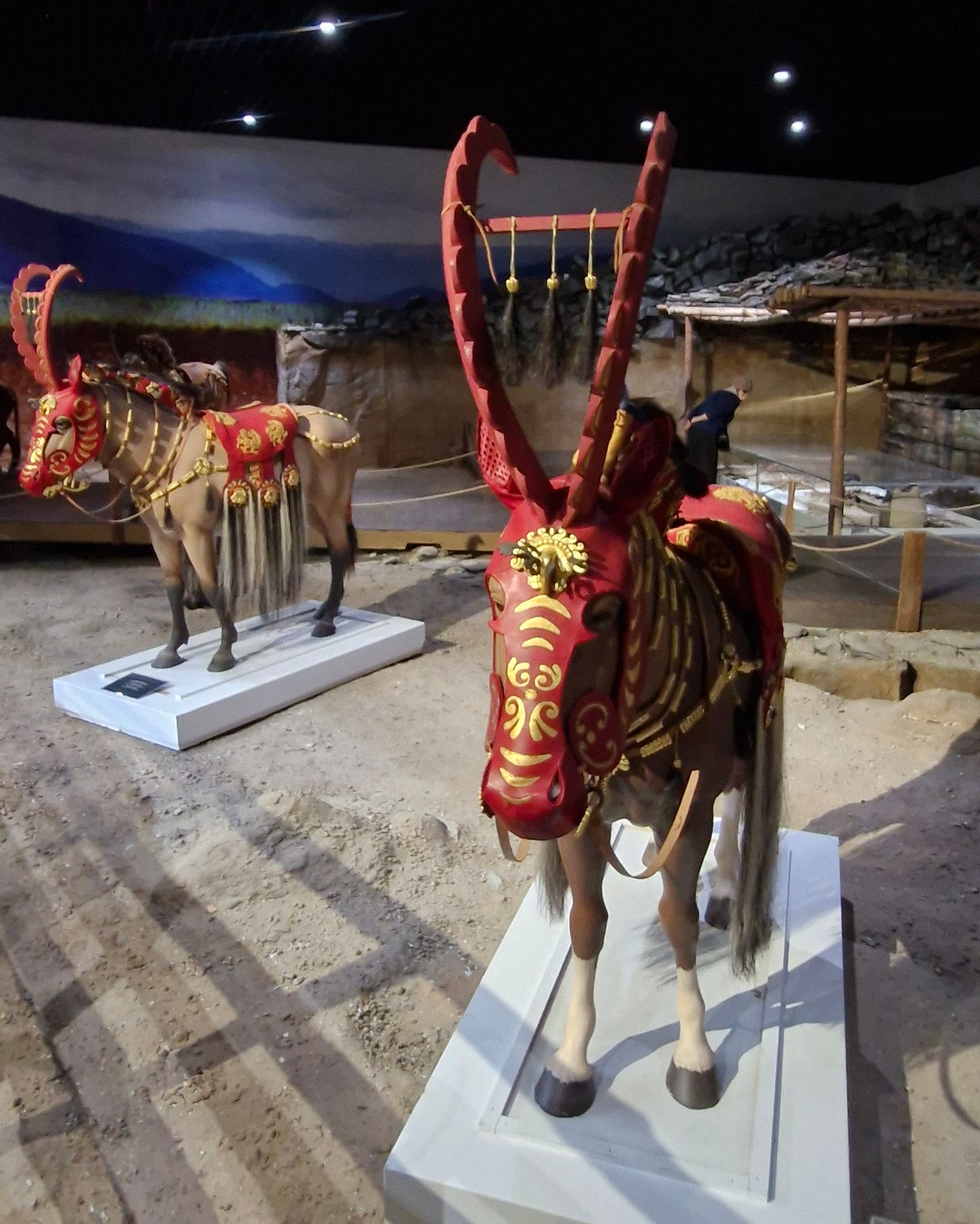
Here, the horse is not just transport. It is identity, the heart of the civilisation.
As for sheep, a precious commodity: they gave wool; wool became felt; felt became clothing, insulation - and the yurt of course: one of the most sophisticated forms of portable architecture ever designed, capable of withstanding extreme continental climates from -40°C winters to scorching summers. So cosy with their central fire and uterine feel.
At the centre of the yurt: the shanyrak - the circular crown, open to the sky. A symbol of home, lineage, continuity. Today, it sits at the heart of the Kazakh flag.
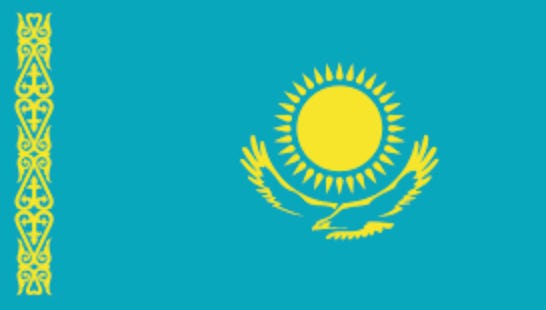
Patterns repeat - the ram’s horn motif, koshkar muiz, symbolising abundance and life. Decorations carry meaning.
Gold, Power, and the Myth of the Empty Steppe
At the National Museum, I met the Golden Man -Altyn Adam. A 5th-century BC Saka warrior discovered in 1969 in the Issyk kurgan, clad in over 4,000 gold pieces. Often described as the “Tutankhamun of Kazakhstan,” he disrupts a persistent Western cliché: that the steppe was empty, peripheral, uncivilised.
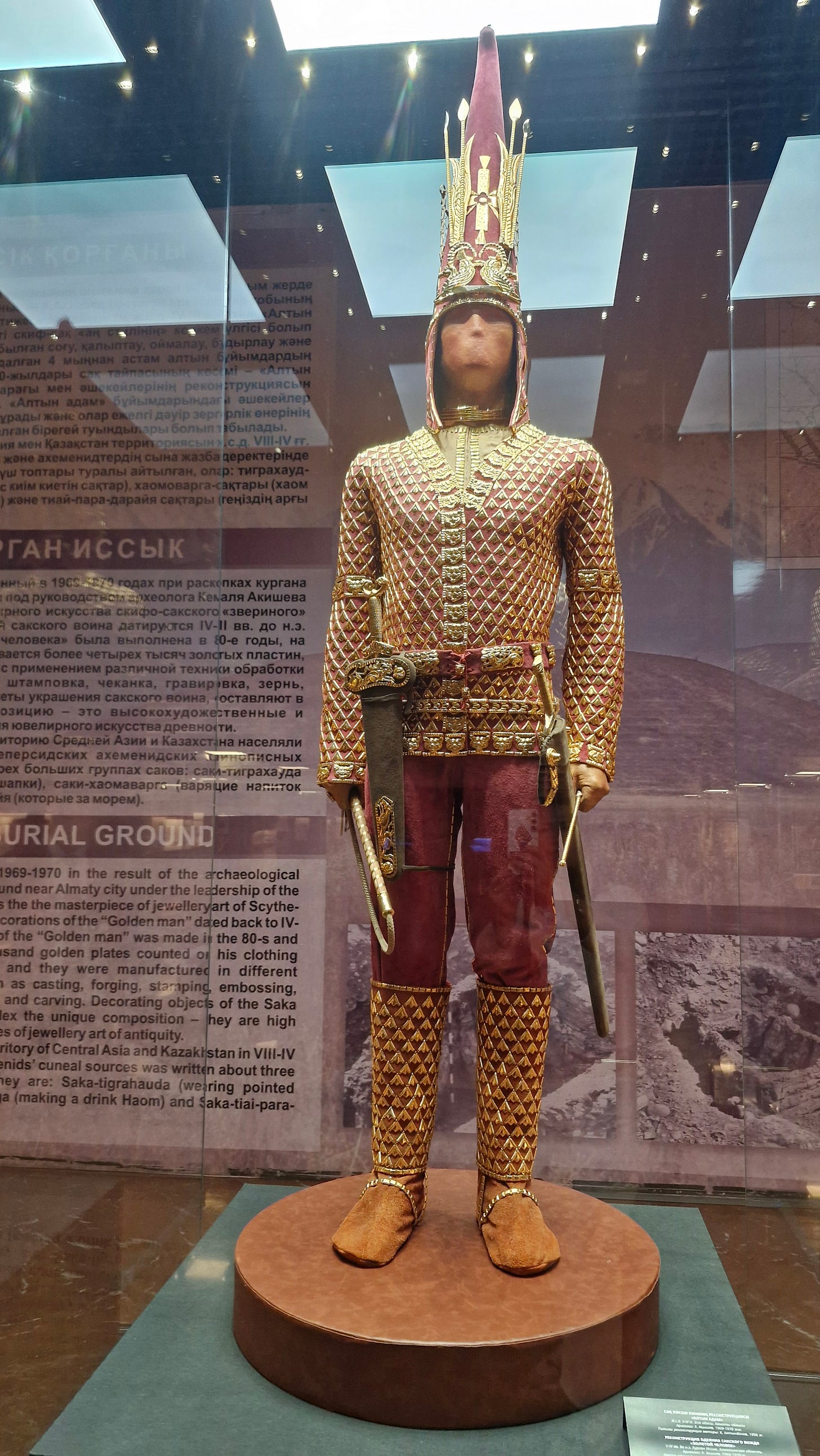
The reality: it was a centre of power, artistry, and belief systems - a space where mobility did not mean simplicity, but sophistication of another kind.
A Night at the Opera, Under the Steppe Sky
And then, the night at the Astana Opera!
A production of Kyz Zhibek - an epic love story rooted in Kazakh folklore. Think Romeo & Juliet… with camels.
Yes, real camels and horses on stage!
Yurts beneath an infinite sky. The Milky Way stretched above. A luminous moon holding it all together.
The costumes were somptious: silk, fur, intricate headdresses. The sets were monumental, opening like secrets to reveal inner worlds.
It was surreal. Generous. Entire. I wanted to pinch myself throughout.
A Different Rhythm of the World
Kazakhstan does not feel like a place trying to catch up. It feels anchored in something older, deeper, continuous, yet fully engaged with the present.
There is modernity - glass towers, megalomaniac architecture, geopolitical ambition, global forums. But beneath it there is also tradition and memory.
A relationship to land not defined by ownership - but by movement, passage, coexistence.
A culture where hospitality was once survival - and remains, today, almost sacred.
In a world that often feels transactional and disconnected, here things feel whole. People look at you. They feed you. They include you. They laugh with you. They are gentle. Grounded. Present.
I leave Kazakhstan each time with a deep sense of gratitude. And the feeling of having been, even briefly, at home somewhere far away.
Until next time - soon, I hope,
Charlotte
Subscribe to get new posts
Peakub is a home for creators, publishers, and teams to publish, grow, and monetize their work — all in one place. We're building a fast, privacy‑respecting platform that helps you focus on your craft while Peakub handles the plumbing — from content tooling to delivery and analytics.

I GO! by Charlotte Kan




Comments