
I GO! Edition 30. (Wo)Man the Hunter
Rewilding Womanhood
10/05/2025
This Week: Washington – Paris – London
It leads to unfair comparisons to leave D.C. on a drizzly evening and wake up the next morning in sun-drenched Paris. I’ll spare you my longer thoughts on how not exactly buzzing the capital of the free world (lol) is - except for the charm of Georgetown and a few decent museums. Paris, meanwhile, turns into a giant celebration of vacuity and obnoxiousness during Fashion Week (unrelated to my professional activities there this week) but remains, absolutely, the most beautiful city in the world. And green, diverse, cultured London? Always home, and where the heart is, especially after 12 consecutive days on the road...But to cut to the chase: in this edition, I will write about the way women are represented in the general societal discourse - and their own willingness to accept it.
This week, I’ve been reflecting on courage - both because it’s the theme of the upcoming Women’s Forum for the Economy & Society (which I’ll have the joy and responsibility to MC next month - can’t wait!) and because I came across figures on the age discrimination women face at work (courtesy of Liora Kern, whose posts always invite reflection).
It triggered a strong emotional reaction - namely, frustration.
Not so much at the reality of millennia of power structures built by men to keep women under control or out of sight - but at women’s compliance. Because the lamenting, asking, bargaining, pleading for men to grant us a share of power perpetuates victimhood and passivity.
Women do not lack courage or strength, but often, audacity.
Boldness. Fierceness. Because we have learned to suppress our natural giant ape aggression and turn it inward instead: punishing ourselves in pursuit of the perfect body, to be the perfect mother, wife, sister, daughter, worker, carer, healer, nurser. Sainthood.
But being a good girl comes at a heavy price: the sacrifice of our dreams, and, worse, our authenticity - our alignment with the real self and its profound needs and desires. Lacking main character energy, too many women fail to lead the story of their own lives.
Compliance, Courage, and ‘Good girl’ syndrome
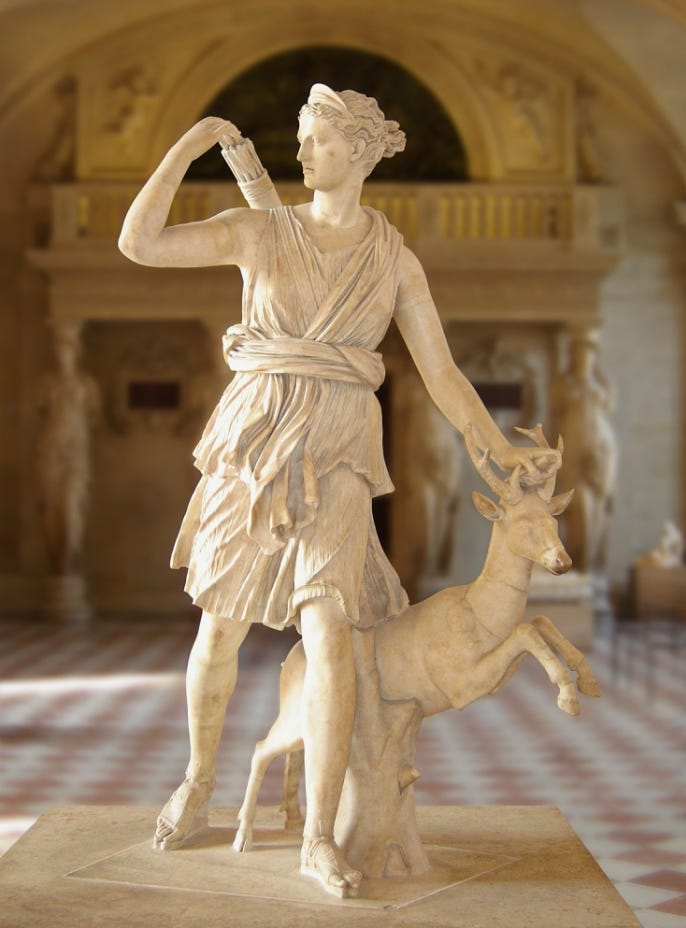
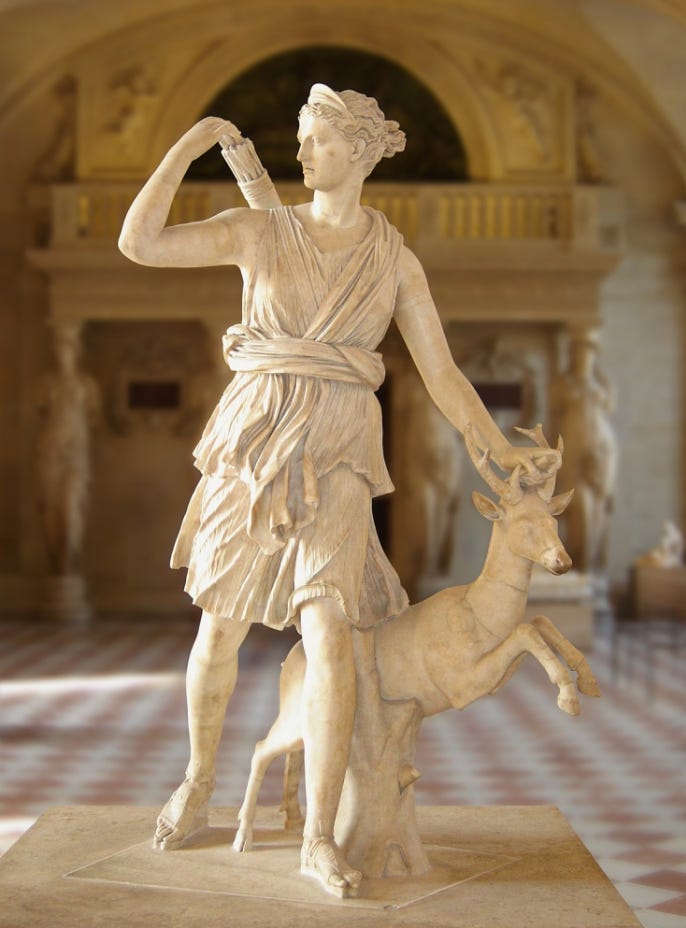
So there is a female archetype I wish more women would channel: the hunter. The lineage of women who go out, cross boundaries and borders, seize what the world offers, and return with spoils that nourish the tribe.
Across history and myth, the female hunter - Artemis, Diana, Atalanta, Dali, the Amazons - is a liminal figure: she crosses thresholds between home and wilderness, nurture and destruction. She is both revered and feared - a disrupter of the established order.
Back in 1966, an academic gathering at the University of Chicago tried to offer, for the first time, a comprehensive overview of research on hunter-gatherers. The symposium was called Man the Hunter. But somehow, it overlooked the “WO” in man and perpetuated a pervasive, dangerous narrative about the “natural” division of labour and that hunting was almost exclusively a male activity when the picture may be more nuanced.
“In prehistoric times, so the story goes, men hunted; women gathered. This gendered division of labour from thousands of years ago explains, supposedly, how and why it is natural for men to lead and women to follow; for men to complete dangerous and heroic tasks while women complete mundane and thankless tasks; and, eventually, for men work outside the home for pay and for women to work inside the home for no pay,” Kimberly Hamlin (American scholar).
The current “trad wife” narrative bubbling up from America’s pop(ulist) cauldron is a blatant fabrication. The idea that, constrained by biology, women’s “natural” role is to stay, gather, wait, and tend to - and that they only recently entered the workforce - is a myth shaped by modern, Western, middle-class ideals.
It’s the cultural construct of 19th-century European bourgeois society, not a historical truth. Until societies became sufficiently abundant, women were out there - toiling in fields, factories, workshops. Feeding mouths.
The Man the Hunter symposium unintentionally crystallised the “homemaker” narrative, reflecting Cold War-era patriarchal norms more than actual anthropological evidence. Its gendered lens downplayed findings of women as hunters and warriors - and in doing so, reinforced stereotypes.
Physical differences don’t preclude women from hunting. Endurance, stealth, ecological knowledge, tool use, and an intuitive connection with nature surely matter as much, if not more, than brute strength.
Several examples in archaeology show women have also hunted, tracked, and pursued.
“Excavations at the Andean highland site of Wilamaya Patjxa reveal a 9000-year-old human burial (WMP6) associated with a hunting toolkit of stone projectile points and animal processing tools. Osteological, proteomic, and isotopic analyses indicate that this early hunter was a young adult female who subsisted on terrestrial plants and animals. Analysis of Late Pleistocene and Early Holocene burial practices throughout the Americas situate WMP6 as the earliest and most secure hunter burial in a sample that includes 10 other females in statistical parity with early male hunter burials. The findings are consistent with nongendered labour practices in which early hunter-gatherer females were big-game hunters,” a recent research project argues.
Similar discoveries have been made in Mongolia, Siberia, and Scandinavia - female skeletons buried with weapons, bearing the marks of active hunting.
And the Ancient Greeks documented the Scythian warrior women of Central Asia - nomadic horsewomen of the 6th–4th century BCE, buried with bows and spears, the likely inspiration for the Amazon myths: women who lived apart from men, embodying autonomy and ferocity.
[It would be un-journalistic of me not to add there was, interestingly, a big controversy when the original 2023, Anderson & colleagues study titled “The Myth of Man the Hunter: Women’s contribution to the hunt across ethnographic contexts” came out and that the scientific community discredited their research stating it overplayed women’s participation in hunting. That is not so much the point, which is to argue women should be more conquering, risk-taking and assertive].
Conclusion:
Power isn’t given. It is made.
Subscribe to get new posts
Peakub is a home for creators, publishers, and teams to publish, grow, and monetize their work — all in one place. We're building a fast, privacy‑respecting platform that helps you focus on your craft while Peakub handles the plumbing — from content tooling to delivery and analytics.

I GO! by Charlotte Kan




Comments