
I GO! Edition 37: Re-enchantment. In our AI-driven world, prepare for a boom of magic, mystery and charisma.
Escaping the Iron Cage through wonder, awe and romanticism
11/29/2025
This week: London
“The fate of our times is characterised by rationalisation and intellectualisation and, above all, by the ‘disenchantment of the world’.”
Science as a Vocation, Max Weber (1917)
More than a century ago, the visionary Max Weber warned that modernity would lead to the “disenchantment of the world” (Entzauberung der Welt). That everything mysterious, magical, symbolic or soulful would be swallowed by the rise of rationality, calculation, bureaucracy, optimisation, process, measurable outcomes. An Iron Cage, with humans bound by market logic, procedural rules, technological dependencies. A world where freedom becomes administrated.
A world predictable, orderly, productive… and emotionally, spiritually empty.
Charisma, in the Weberian sense, is the force that breaks the Iron Cage - the human glow no system can replicate. It is the disruptive energy of presence, emotion and intuition, the kind of authority that does not come from rules or structures but from the inexplicable pull of people who make others feel alive.
Last week, I wrote about the return of the Humanities, and how in a hyper-rationalised world obsessed with optimisation and efficiency, people are disconnecting from the value of language, art, philosophy, history, literature. The disciplines that teach us to see, feel, interpret and make meaning. The return of the Humanities is only the beginning. The real movement is the return of the human.
“The world remains a great enchanted garden to every child, and to the believer. But to the modern intellectual, it is no longer so.”
Max Weber
I am a hopeless romantic - but not in the narrow, sentimental, naive sense – more in the philosophical meaning of the word. I believe in the primacy of emotions in our hyper-rationalised world, that feelings are data, sensitivity is a method, a form of intelligence to better read this world.
Romanticism is not a retreat into sentiment, but a philosophy of re-enchantment – a conviction that awe, intuition, joy and longing a way of restoring colour, texture and meaning to a world that has become too flat.
That is why I launched this newsletter: to share the emotional pulse I experience when discovering new lands, new foods, new people. The sense of wonder in ancient, liminal cities dripping with stories and tales like Samarkand, Kyoto or Venice. Those moments that are too full to articulate. Too full to measure.
Weber lived in a world of factories and séances in candlelit parlours
Although Weber lived at a time when the world was industrialising and becoming “disenchanted”, Europe and America experienced a massive re-enchantment boom simultaneously.
Weber’s work from the late 1800s to the early 1900s coincides with the fast development of railways, telegraphs, electrification, scientific bureaucracy and industrial capitalism. Modernity at full speed. But at the same time, society was gripped by an extraordinary surge of spiritualism, occultism, astrology, tarot, alchemy and esoteric Eastern philosophies (Buddhism, Vedanta, etc.). Victorian England was particularly obsessed. So were Paris, Vienna and New York.
The more rational the world became, the more people turned to magic. This is classic Weberian dialectic: rationalisation produces its own backlash.
In the arts and literature, symbolism, surrealism, Wagnerian mysticism, Yeats’s magical theories, Nietzsche’s Dionysian revival were all part of the re-enchantment a century ago. Even Carl Jung, a contemporary of Weber, built an entire psychological system on mystical archetypes, dreams and the collective unconscious.
And today? Where are we looking for the magic?
Our modern titans do not inspire us. For all their brilliance, for all their audacity, for all their moonshots and Mars colonies, the Thiels, Musks and Bezoses of this world are failing in one essential domain: they do not transport us somewhere mysterious and exciting. All they offer is spectacle without soul. Their worldview is fundamentally Weberian, the apex of rationalisation, optimisation and hyper-productivity. It is not a vision of humanity. It is a vision of capacity.
Their worldview and achievements tell you what is possible, not what is beautiful, sacred or should be cherished. They promise us the future, but without giving us a reason to want to live in it.
Re-enchantment spikes whenever rationalisation reaches a breaking point:
• Industrialisation led to the Victorian occult and spiritualism boom.
• Post-war bureaucracy gave birth to 60s mysticism, counterculture, psychedelia.
• Digitalisation and AI in the 2020s→ ?
In an age of algorithmic governance and data fetishism, we are witnessing the rise of modern mysticism and “neo-spirituality”: from energy healing to manifestation practices, lunar calendars, rewilding (I am currently reading the excellent and liberating Women Who Run with the Wolves by Clarissa Pinkola Estés on unleashing our passionate creativity and deepest anima), to the embodiment and somatics movement (nervous system awareness, polyvagal theory), the psychedelic renaissance (psychedelics, trauma healing), and a deepening interest in the sacred feminine (goddess archetypes, Yoni and sexual sovereignty, sisterhood circles, etc.). All of it is a form of rebellion, a counterweight to the disembodied, hyper-cognitive logic of the digital age.
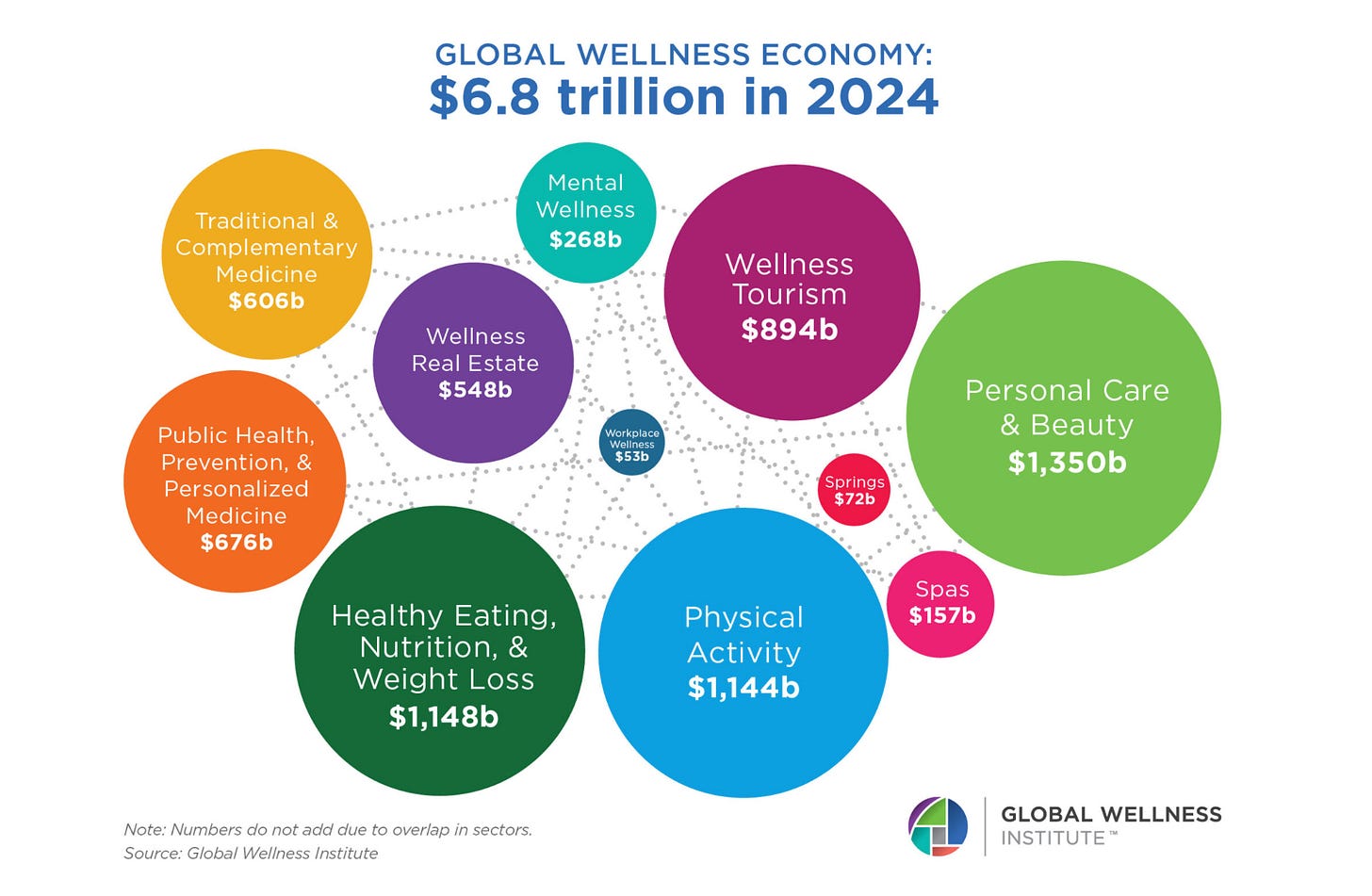
This helps explain why the global wellness economy has doubled in size since 2013, and why “mental wellness” in particular (including mindfulness, meditation, etc.) is among the fastest-growing subsectors, with annual growth rates in double digits.
Younger generations are behind this move. The 2025 “Future of Wellness” survey by McKinsey finds that Gen Z and Millennials are driving demand across wellness subcategories, and that they are spending disproportionately on wellness.
Another sign: globally, “spiritual services” (including meditation, mindfulness, healing services, spiritual counselling, etc.) are proving a lucrative sector, already estimated at around US$392.5 billion in 2025, and expected to grow 7.5% annually through 2033, with North America, the cradle of big tech, the market most in demand.
This is the measurable part. But with re-enchantment, not everything can be weighed. Some things remain qualitative: longing, nostalgia, myth-making, interior lives. The data reflects market choices, not inner states.
However, the scale of growth, from tens of billions to trillions of dollars globally, suggests this is not just a niche underground phenomenon, but a mass societal shift, already embedded in economies, daily lives and generational values.
It makes us realise we need to think deeper about our progress metrics, from GDP growth to more soul-oriented living.
The next revolution will be felt. It will be slow, sensual, sensorial, very deep - a reclamation of our mystery, of our humanity.
Subscribe to get new posts
Peakub is a home for creators, publishers, and teams to publish, grow, and monetize their work — all in one place. We're building a fast, privacy‑respecting platform that helps you focus on your craft while Peakub handles the plumbing — from content tooling to delivery and analytics.


I GO! by Charlotte Kan




Comments