
I GO! #40: The ones who leave
On curiosity, worlds-crossing, and the price of becoming yourself.
03/14/2026
“And it’s no good waiting by the window
It’s no good waiting for the sun
Please believe me, the things you dream of
They don’t fall in the laps of no one…
It’s no good waiting…
You got to go to the city!”
George Michael, Flawless/Go to the city
Did you leave?
A place. A family. A culture. An expectation?
Got your one-way ticket, a ride on that social elevator, a crash course in self-belief - knowing there is no return?
So you could finally become yourself, do life on your own terms, love who you wanted, breathe?
This one is for the misfits. The outsiders. The reluctant rebels. The class-crossers. The cultural exiles.
The hungry kids.
The ones who leave.
Coming from “Nowhere”
A bright and ambitious young man approached me recently after seeing me on stage. He asked for tips on how to present better during interviews. He wants to work for one of the big consultancies and finds the process intimidating. He comes from a humble, provincial background. From “nowhere,” as he put it (feel the weight of that word, the heaviness of social judgment…). This is not his world. He doesn’t know the codes. I come across so confident, but also very much myself. Could I share some advice?
“Why?” I asked him. “Why do you want this so badly?”
“To validate my journey,” he said. “The culmination of everything I’ve worked so hard for.”
My heart sank. I know what comes next. He gets the job, contorts himself to fit in. He learns fast. Wear what they wear. Change his accent. Use their expressions. Learn their language. Gets into their skin, buys the same loafers, the expensive suits: method acting.
One evening a colleague invites him to dinner in a beautiful flat with high ceilings and shiny parquet flooring. The kind of place he has never seen before.
Women wear Cartier rings, men family heirlooms. Everything looks glossy and expensive - including the humans.
They will talk about skiing in Courchevel, parties in Saint-Tropez, polo in Argentina.
He will sit quietly, trying to decode everything.
So many plates, which knife for the butter?
When to laugh.
What reference to pretend he understands.
“Cultural capital” as Pierre Bourdieu called it - this invisible web of codes and bonds that signal who belongs and who doesn’t. The famed French sociologist, who came from a humble rural background himself, argued elite institutions reward those who possess that capital, and how outsiders must learn these codes consciously – and quickly - to be able to play the game and, hopefully, “win”.
And indeed, after a few years, the young man has become an ethnologist. He switches accents, manners, conversations, tone quickly. He “gets” the crowd - almost instinctively. He’s washed himself off the original sin, the stench of the country, has won at social snakes and ladders.
And then one day, after years of “levelling up,” he will quit the job where he excelled but which he hated. None of this will matter anymore. He always disliked those dinners and parties anyway. He does “different things” now. He is not ashamed anymore, he’s found himself, he knows how it works. And he’s not impressed.
The drive of the outsider
Something I have observed myself based on the myriad interviews I have conducted with leaders from various sectors: people from modest or provincial backgrounds are often overrepresented among high achievers. Some sociologists describe this as “the drive of the outsider” or “status anxiety motivation” (British philosopher Alain de Botton explored it in ‘Status Anxiety’).
American sociologist Robert K. Merton, the man behind ubiquitous terms such as “self-fulfilling prophecy,” “role model,” and “focus group” called it “relative deprivation”: when people compare themselves to higher-status groups, the gap can generate strong achievement motivation.
But let’s return to the young man, who’s now older. The people back home, his closest, they have seen the change from afar - and they don’t like it. He always wanted more. He’s moved on. Here, it’s not good enough for him. They tease and mock him, micro-humiliations - to hide their own sense of inadequacy. Truth is: they don’t even understand what he does, so they pretend not to care. They say ‘ambition’ like it’s a dirty word. Every visit he feels more and more tense - and unwelcome. The conversations are the same as when he left. It feels awkward. The air outside is clear, yet he suffocates.
Freedom has a price.
“I felt I had betrayed my class,” said Nobel Prize winning author Annie Ernaux in La Place. Ernaux in the book describes the “double-impossibility” of an individual who has moved from their working-class roots to the bourgeoisie through education. A social migration that cut an “internal tear,” where the individual no longer belongs to their class of origin but never feels fully assimilated into their new elite social circle.
Migrants feel it too.
More than a century ago, W. E. B. Du Bois wrote about double consciousness - the experience of seeing oneself through two incompatible worlds at once. One identity rooted in where you began, another shaped by where you arrived. Two cross-worlds, and you learn to live in that fracture.
You’re elastic, adaptable, can think outside the institutional or social box, become fluent in several languages, several codes, several identities. A shapeshifter - and that’s your superpower.
The Peninsula
I always wanted a BIG life. A life of travel, ideas, discoveries and abundance.
But I grew up in a village, on a peninsula, surrounded by water.
Five hundred people.
A bakery.
A bar - frequented by drunks.
And a library (my sanctuary.)
The landscape was luminous. The people kind.
Expectations were low.
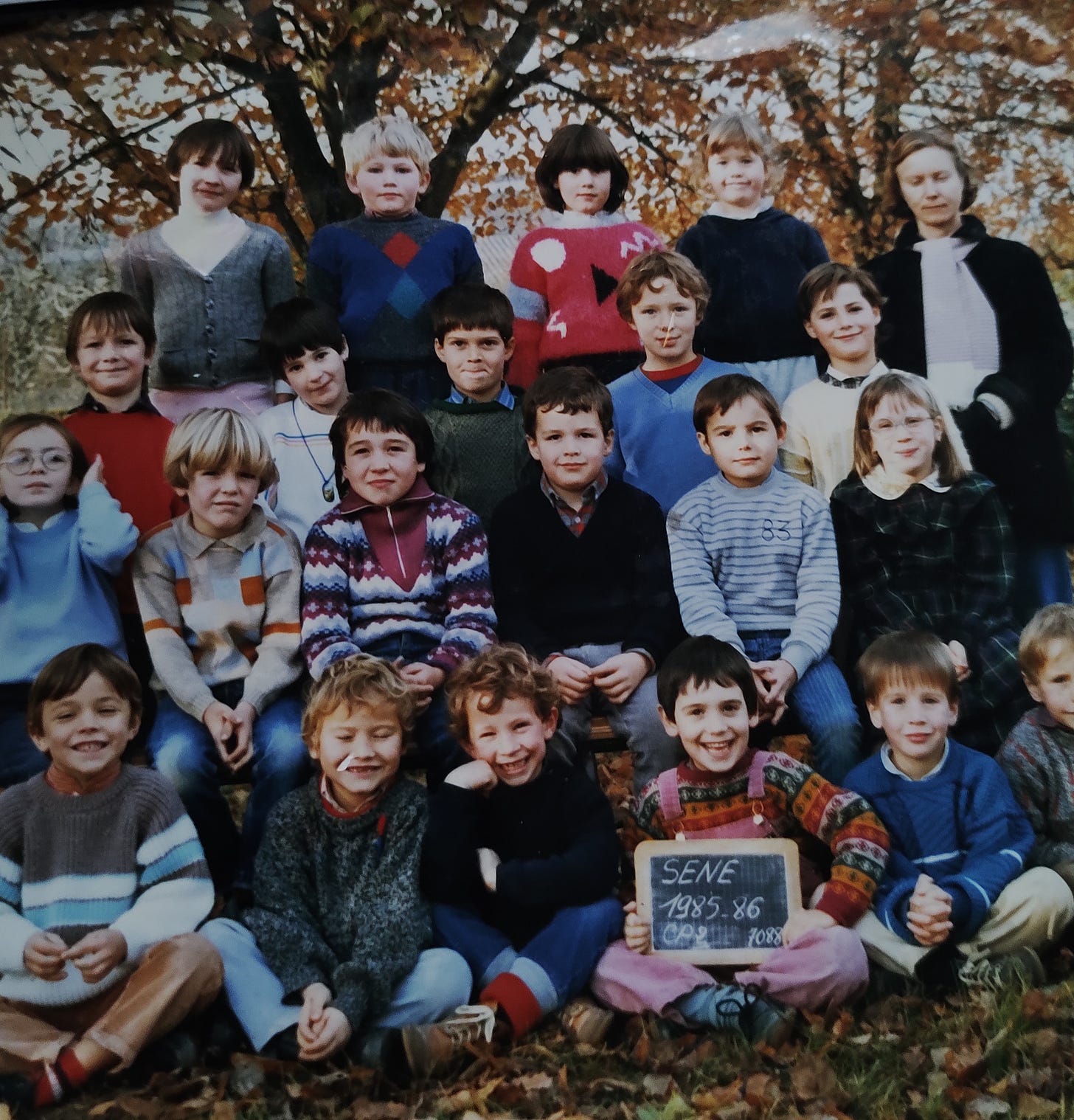
The school bus every morning to school in the nearby town, where you sit alone at the back in full “emo” gear, reading Dickens or Stephen King while the other kids discuss the footie the night before.
The sneers because you love books, good grammar and deep conversations: your “superior, bourgeois attitude.”
Besides, you’re not even a proper villager. Your parents are townies. Their house a modern oddity. They work in the “tertiary.”
The solitude. The tedium. The silence that makes you want to scream.
The cigarettes stolen from your father smoked pensively on the window ledge, watching the sun fall over the fields, Nirvana playing in the background.
Imagining all the extraordinary things happening out there in the world - while you are stuck HERE.
And you loathe it all: the injustice. You feel trapped. Surely, this all a misunderstanding, a mistake?
You dream of a glorious, exciting, Romanesque life - the right life for you.
Killer heels, black dresses and expensive lipstick.
Cocktails in dimly lit bars somewhere in Hong Kong or New York.
Underground clubs in Berlin, raving for hours until morning.
Vernissages in Paris where the Champagne flows and laughter rings out, crystalline and clear.
Interviews with nonchalant writers for Time Magazine or Vanity Fair.
Sleeping under mosquito nets in the heart of Africa.
Getting lost alone in ancient cities with many names, depending on the century.
Sailing the turquoise waters of inner seas, your hair whipping in the wind.
A heroine. That’s what you want to do when you’re older.
How crushed you feel by the ordinary. The routine. The boredom. The lack of wanting more.
“You’re wasted here, you’re a star
In this small town of hand-me-downs who don’t even know it
Sometimes it brings you down
Sometimes it eats you up
Sometimes you think that your head’s going to blow
It doesn’t, it doesn’t, it doesn’t, it doesn’t
It doesn’t get better
Don’t you know, you got to go to the city
You got to reach the other side of the glass
I think you’ll make it in the city baby…
I think you know that you are more than just
Some f*cked up piece of ass” George Michael, Flawless/Go to the city
Then you turn 18. University in a “proper” city. Relief: the people there, they resemble you.
But that’s still not enough.
Off to an adventure: another country. Where you feel even more alienated: you become a FOREIGNER. Your accent, your background, your manners. Who you know, or don’t. What you know - or don’t: none of it applies anymore.
No one is watching. You are a nobody. You are nothing - thus completely FREE.
Geography as destiny; curiosity as currency
You go to the city or a new country for the same reason everyone does: because the city is where new lives are possible.
City means anonymity. Your parents, your history, your mistakes… Your identity is not fixed by the community, allowing self-reinvention.
Moving to high-opportunity cities also obviously significantly increase upward mobility, because cities concentrate opportunity, education, networks and cultural capital. A major study by Raj Chetty found that children who grow up in or move to cities earn significantly more as adults than those who remain in low-mobility regions. People who leave rural or small-town areas for large cities earn 20–30% more on average over their lifetime than those who stay.
But it’s not about money, really: it’s about accessibility - a life richer in experiences.
Furthermore, cities dissolve rigid hierarchies. Small communities often have very stable social structures. People know their “place” (the expression I possibly hate the most) – in a big city, you create your own. Sociologist Georg Simmel wrote in The Metropolis and Mental Life that cities create a new type of person: more individualistic, more experimental, less bound by tradition. It enables plural identities.
Yet leavers are not as common as you think. Across OECD countries: only about 10–15% of people move very far from where they grew up. So the people who truly leave - new country, new networks, new identity - are a minority.
And who are the leavers? Why? One psychological trait appears again and again among people who leave small environments to build different lives: high “openness to experience” (See Todd Kashdan’s Curious’).
In the Big Five personality traits framework, openness is the trait most strongly associated with people who seek new environments and identities.
People high in openness tend to:
be intensely curious
seek novelty and difference
enjoy ideas, books, art, and culture
feel bored or constrained by routine environments
imagine alternative lives early
They mentally leave long before they physically leave, and books, music, films, and ideas become the first exit routes. Researchers call it “early cognitive escape”, with many “leavers” describing the same childhood habits:
reading obsessively
imagining other places
listening to music that connects them to another world
feeling intellectually, emotionally or culturally out of sync with their surroundings
Another trait is high tolerance for risk and uncertainty and stronger internal motivation, because leaving means accepting financial instability, loneliness, the possibility of failure and identity reinvention – and most people avoid that.
Psychologists call this the internal locus of control: the belief that you can shape your own life rather than accept the one assigned to you.
Being a leaver is an incredibly difficult journey. It’s also the most elating.
James Baldwin said: “Perhaps home is not a place but simply an irrevocable condition.”
I disagree. Nothing’s irrevocable.
Your curious life traveller,
Charlotte
Subscribe to get new posts
Peakub is a home for creators, publishers, and teams to publish, grow, and monetize their work — all in one place. We're building a fast, privacy‑respecting platform that helps you focus on your craft while Peakub handles the plumbing — from content tooling to delivery and analytics.


I GO! by Charlotte Kan




Comments