
✨ I GO! | Edition 14: Craving Venus - Yearning for the Return of the Feminine Principle
From Conquest to Reconnection: Unlocking Soft Power, Intuition, and Grace
06/01/2025
This Week: Astana
“Know, O man you are a particle of the supreme feminine being sucked to an obscure vacuum - of a bliss but that we can only name - universe!”
― Preeth Nambiar, The Solitary Shores
Wrote my little ode to life’s serendipities, on the flight home from Kazakhstan, where, under the vast skies of the steppe, today’s challenges and possibilities were debated at the Astana International Forum. President Tokayev in his opening address talked about a world at “an inflection point,” on the verge of a big change. I feel it coming too, as something is increasingly stirring inside me...
We are out of kilter
What if the world doesn’t need more AI, more efficiency, more performance…but more connection – to our environment, our bodies, our celestial souls?
Whatever the tech bros, authoritarian strongmen, and fragile egos of all feathers would have you believe, the world doesn’t need more masculine energy right now. We need its complementary force: feminine power.
The world urgently needs to reclaim, restore, and revere feminine energy - which is not just about women per se, but what is present in all of us - the feminine principle.
In a world filled with rationalism, logic and materiality, the feminine principle is often defined as a superior, cosmic force related to intuition, nurturing, and the receptive aspects of creation.
Vs.
The masculine principle - action, logic, and the assertive aspects of creation.
The feminine is vast - expansive, timeless, larger than the visible world.
The masculine focuses - it narrows, sharpens, and defines.
The archetypal feminine is in all of us but is terribly wounded and has recoiled. Here’s how Mo Gawdat, former Chief Business Officer at Google X - now an advocate for conscious tech and better living after experiencing a personal tragedy (the worst, ever - the loss of a child) - puts it:
“My analysis says there is a statistical correlation in terms of the recurrence and intensity of certain traits among the biologically female as well as the male so that is why I call them feminine and masculine traits. And the reason it’s important to identify them is because we have all suppressed many of them […] We live in a capitalist world that is driven by predominantly masculine traits - it’s competitive, results orientated and about ‘doing’. We don’t use many of our feminine traits that are about ‘being’, such as intuition, because we’ve been led to believe they’re not as valuable, that they don’t contribute enough to making a salary at the end of the month or producing more stuff. But we’re ‘doing’ too much of the wrong thing. The traits that inform us of the right things happen to be feminine - creativity and empathy - and we need to magnify them to help bring more joy to the world.”
Ah, intuition. ‘Sensing’- the quiet and powerful intelligence of listening, observing, feeling, opening up, being receptive to gather subtle clues, the feeling before the reasoning…The mind of the Universe at play?
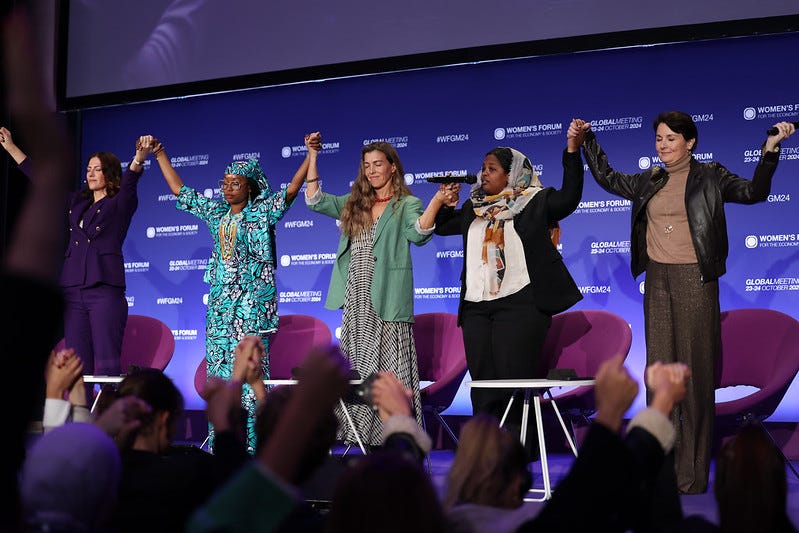
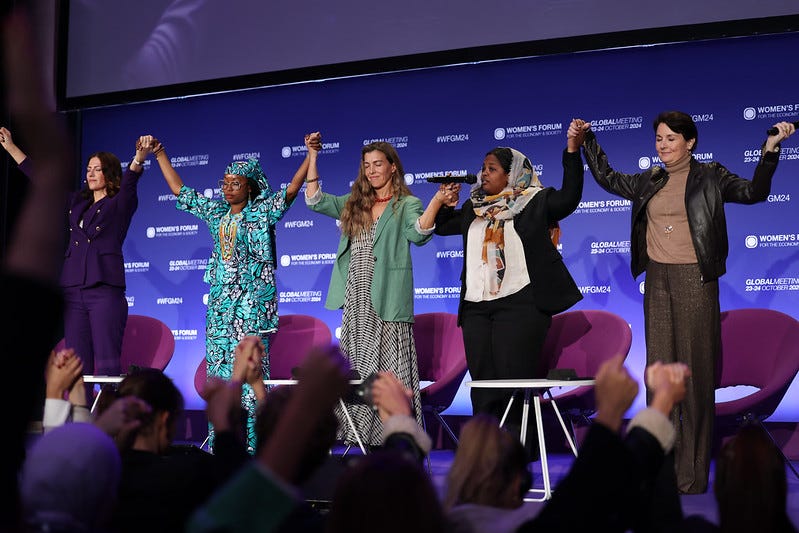
AIF 2025: Empowering Women, a priority
One of the ways to unleash the feminine principle is, of course, more female leadership.
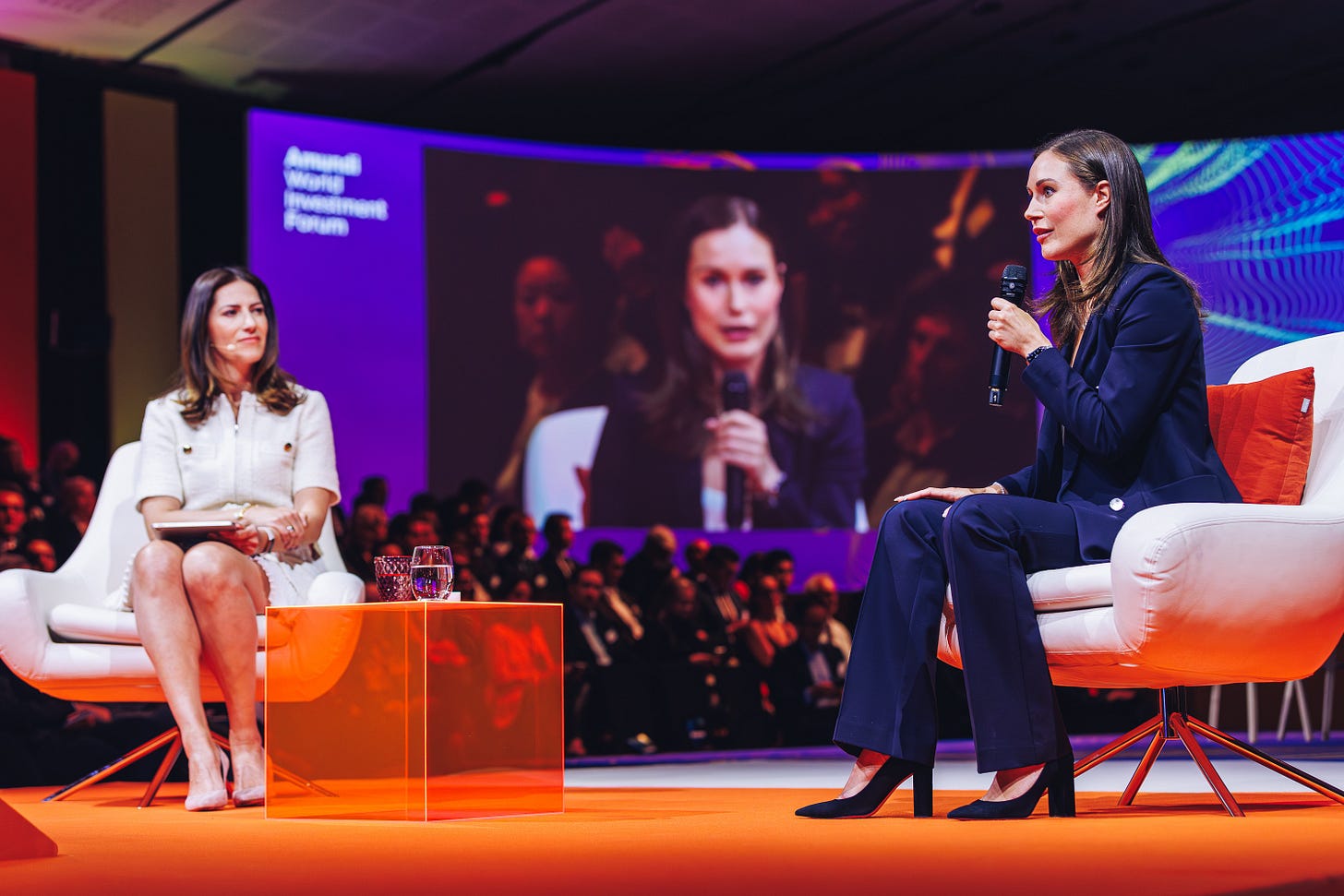
There were many calls for the empowerment of women at the Astana International Forum, where I moderated several conversations on digital transformation and youth inclusion - and had the honour, as a passionate communicator on a lifelong journey to refine my art, to conduct a one-on-one interview with a man who has developed great Mastery in the field, allowing him to shape national narratives: former comms advisor to British PM Tony Blair, Alastair Campbell.
Not only as sharp and stimulating as expected, but also warm, authentic, and remarkably approachable - a masculine archetype, yet grounded in enough empathy, vulnerability, and emotional intelligence to disarm and deeply engage.
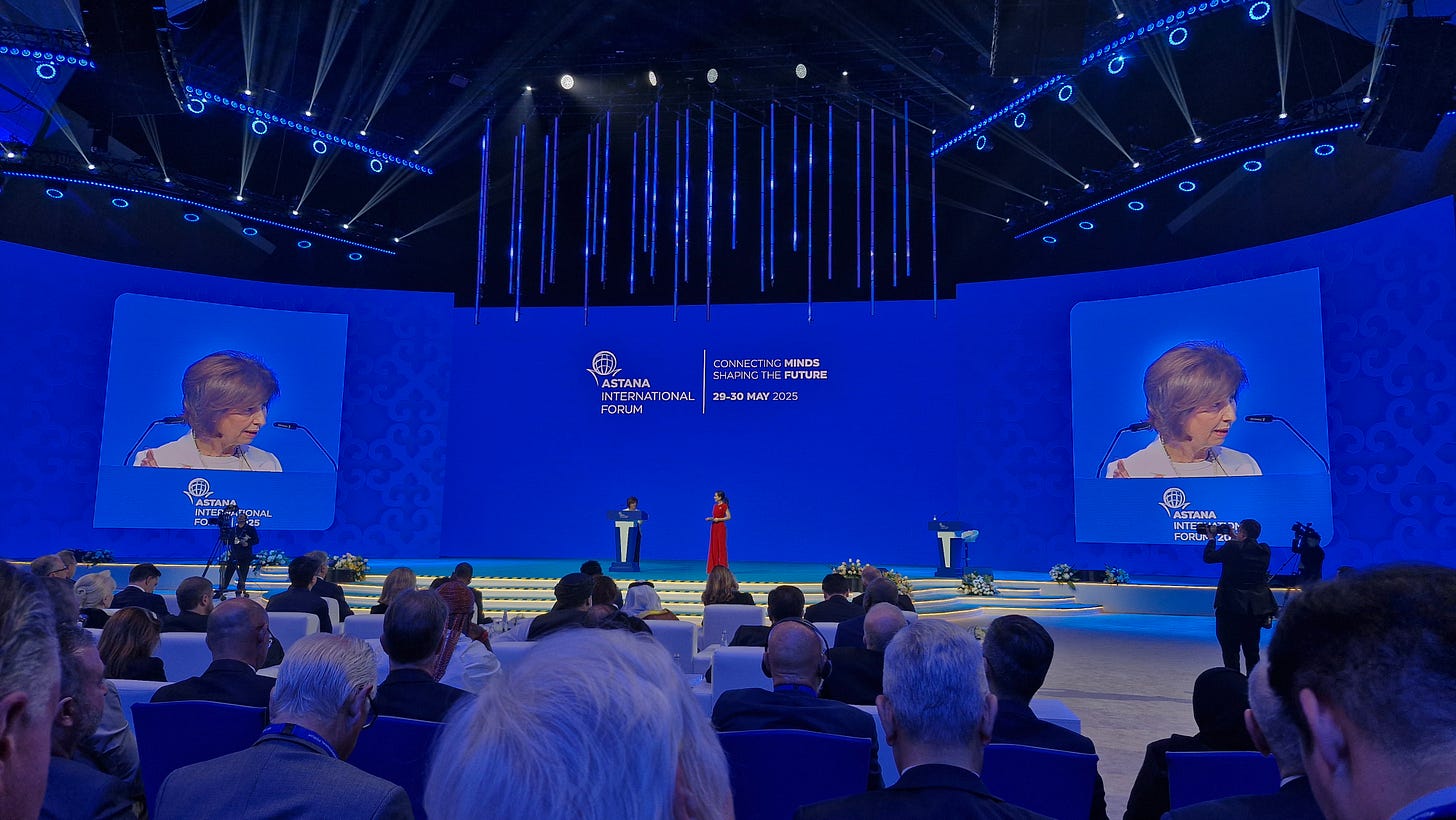
What stirred my soul at AIF was a single moment, when, during the opening plenary, a female Head of State was asked whether the next UN Secretary-General should be a woman. The fact that this still feels like a daring question says everything about how women’s rights today, as the question, somehow, remains subversive: how could a woman lead one of the world’s most powerful institutions? How could she decide, own her body, or just breathe and live without permission, in her own terms?
And then she answered: “As James Brown said: it’s a man’s world. Mars governs that world.
But the world also needs Venus.”
- President Gordana Siljanovska-Davkova, North Macedonia
Venus.
Not just the goddess standing on a clamshell, but the brightest star in our sky, radiating in full force: Relational intelligence. Emotional fluency. Harmony with Nature. Connection with our generous, cyclical bodies. Aesthetic power. Empathy as strength.
From the start our proto-capitalist, agriculture society (highly recommend ‘Sex at Dawn’ by Christopher Ryan and Cacilda Jethá which links the development of sedentariness and smallholder farmers to the switch from egalitarian societies of hunters-gatherers to monogamy and women becoming "property"), and especially since the Industrial Revolution, we’ve built a world ruled by Mars: Conquest. Extraction. Speed. Domination.
Mars built the modern economy.
Mars engineered our global systems.
Mars glorified the grind.
And now we are burning out. Spiritually. Ecologically. Emotionally.
What we’re craving, though we rarely name it, is Venus.
We crave meaning, beauty, and kindness.
We crave fairness in leadership, balance in politics, empathy in innovation.
We crave systems that care, that include, that nurture, not just scale.
We crave intuition alongside logic. Humanities alongside Sciences.
Art and culture not as afterthoughts - but as the beating, creative heart of human genius.
We crave a world where inclusion is the currency.
We crave Venus.
She whispers through the conversations I moderate,
Through the cities I visit,
Through the longings I hear from women and so many men, everywhere.
We all sense it: something essential is missing.
And we are ready.
Ready to call her back.
To restore the balance.
To welcome the other half home.
Nomadopolis
This was my fourth visit to quirky but loveable Astana.
If some parts of the city feel like the set of the Bioman series, that’s no accident. Much of its layout and architecture was designed by the visionary Japanese architect and 80s staple Kisho Kurokawa, one of the founders of the avant-garde Metabolist movement, who blended futuristic lines with nomadic symbolism (not always to great acclaim, me thinks).
Picture golden towers, pyramid-shaped cultural centres, bland blocks of flats, and a giant tent-shaped shopping mall - Khan Shatyr (complete with a beach on the top floor!), designed by Norman Foster. A kind of Central Asian Dubai meets post-Soviet theatre set.
Allow me to stretch the metaphor a little: like Canberra or Brasília, these purpose-built capitals with feminine-sounding names often embody a deeply masculine energy - monumental, concrete-heavy, power-forward in design and intent.
Astana is no exception.
A new city of 1.5 million, it only became Kazakhstan’s capital in 1997, yet has already cycled through at least five names since 1830 - a chameleon of identity, a haven for the +100 ethnic groups that make up the country, reshaped by history, ideology, and ambition.
From Akmoly (“white grave” in Kazakh), originally a Cossack military outpost, to a series of identity makeovers, it was renamed Akmola under Soviet rule in the 1960s, then Tselinograd (1961–1992) during Khrushchev’s Virgin Lands campaign. After Kazakhstan gained independence in 1991, it reverted to Akmola, before being renamed Astana (“capital” in Kazakh) in 1998. In 2019, it briefly became Nur-Sultan, in honour of the country’s long-serving president Nursultan Nazarbayev. But in 2022, amid growing public discomfort with personality cult politics, President Tokayev reinstated the name Astana
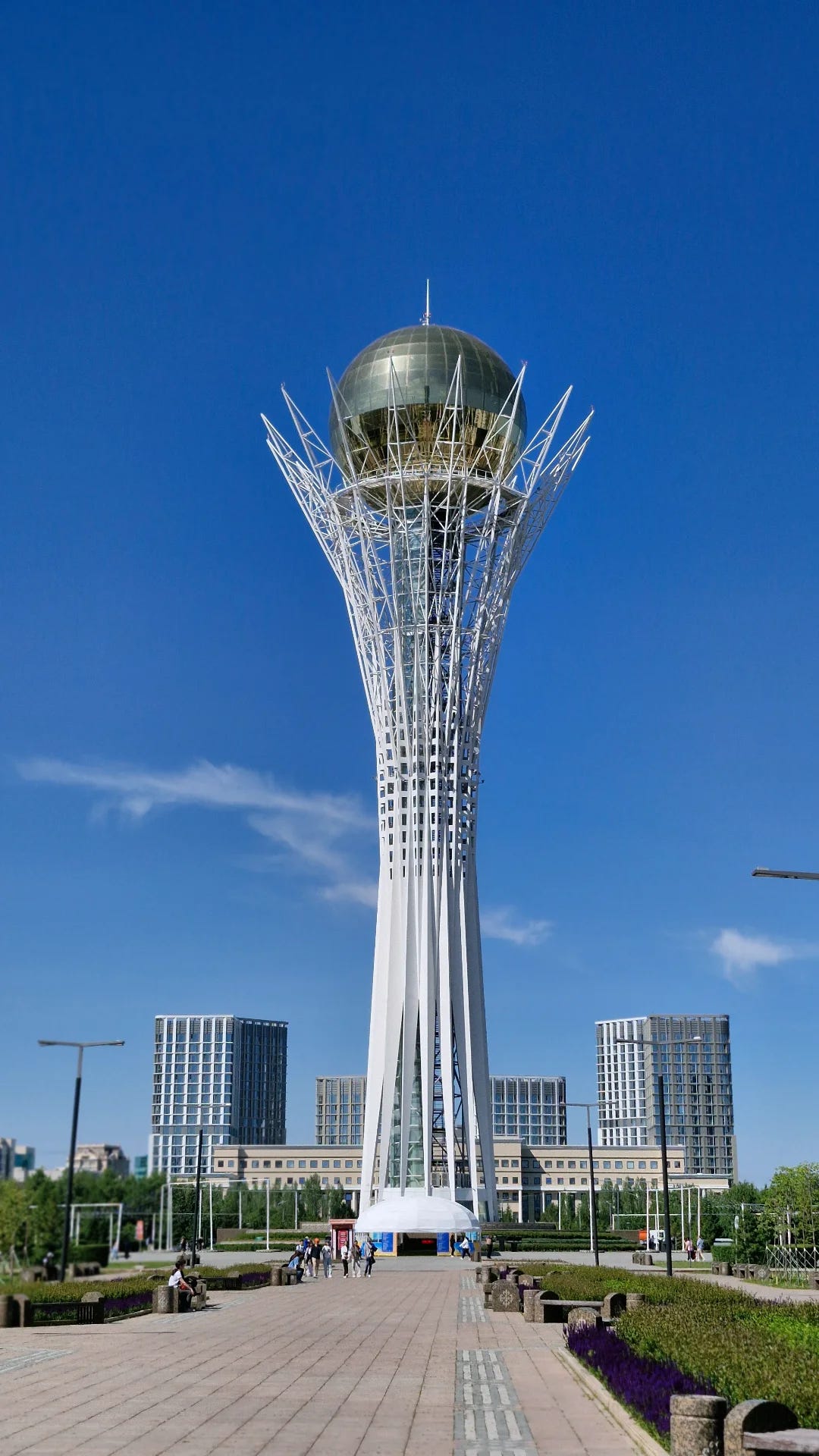
And of course, there’s the iconic Baiterek Tower - a national symbol inspired by a Kazakh myth about a sacred tree and the magical bird Samruk, who lays her egg in its branches. Visitors, often multigenerational families, queue to place their hand in a golden imprint of Nazarbayev’s palm at the top - which I did myself back in October during the Astana Think Tank Forum (a fun expedition by foot in an unwalkable city with fellow moderators and panellists!).
Astana is an unusual choice for a capital - not least because it’s one of the coldest in the world, with winter temperatures often dipping below –30°C. And yet, it’s lively, buzzing, and... the traffic is a nightmare.
I enjoyed a traditional Kazakh dinner with my former Bloomberg colleague Ryan and his lovely daughter Yana at Sandyq, where the sour, yeasty goat (or whatever animal) milk felt less like a treat and more like a humiliating form of punishment.
The succession of horse meat cuts (don’t judge), dumplings, and vegetable dishes, however, was delightful though.
Other highlights? Another memorable night at the Astana Opera, and being serenaded by Kazakhstan’s biggest pop star, Dimash! What an incredible voice, and what generosity from our hosts!
Kazakhstan is an extraordinarily hospitable country, central-Asian style. Its people are genuine, friendly, so welcoming. I can’t wait for my fifth trip - and next time, I promise to finally visit the birthplace of apples - Almaty.
From the vast, galloping steppes, with a full heart and a renewed mission, soulfully yours, Charlotte
Subscribe to get new posts
Peakub is a home for creators, publishers, and teams to publish, grow, and monetize their work — all in one place. We're building a fast, privacy‑respecting platform that helps you focus on your craft while Peakub handles the plumbing — from content tooling to delivery and analytics.

I GO! by Charlotte Kan




Comments