
I GO! Edition 4 – AI-topia: In Love with a Strict Machine
AI could wipe out Mankind—not by killing us, but in a much subtler, more insidious way: by loving us too much.
03/08/2025
This Week in Go! London - Barcelona
In Love with a Strict Machine
This week, I found myself once again in Barcelona for my annual pilgrimage to MWC, the global tech fest showcasing the future of connectivity.
As I moderated conversations, probed telco industry leaders on the transformative power of AI and automation, and walked through halls lined with flashing LED screens, robot dogs, drones, and other AI-driven innovations, I couldn’t help but find the air thick these days with the same AI-utopian enthusiasm that many displayed in the mid to late '90s. At the time, many believed that the mass deployment of the Internet and the creation of our Information Society would solve many of the world’s problems—from conflict to hunger and well-being. (I explored 90s digital utopianism in my podcast about the decade, Xennials: The Last Analogue Generation, on YouTube).
And yet, here we are, in a world where, despite (or perhaps because of) digital hyperconnectivity, we’ve never felt more unsettled—staring into the abyss of global conflict and feeling more alone than ever. I can’t shake the feeling that we’re sugar-coating the reality of an algorithmic world.
AI could indeed wipe out mankind—not by killing us, but in a much subtler, more insidious way: by loving us too much.
Friends Electric
The military historian and intellectual Yuval Noah Harari, in his brilliant but slightly anxiety-inducing book Nexus, tells the story of how information networks were made and unmade, from the Stone Age to AI. He argues that what stops humans from making good decisions isn’t a lack of information but rather how they use it to eliminate perceived “problems”—be they foreigners, people with different political views, women and minorities demanding equal rights, civil servants, intellectuals, people who wear glasses, or those who love people of the same gender etc. There’s never a shortage of enemies to target in the idealistic pursuit of a supposedly better world. And in this pursuit, the end justifies the means—which means violence.
His message, in essence, is that the real danger of AI isn’t in machines turning against us—it’s in us willingly surrendering to them, believing they will make us happier. And if there’s one area of life where people desperately seek happiness and luck, it’s love.
Increasingly, isolated humans are turning to machines to fulfil their innate, universal need for social acceptance, validation, protection—and sex.
The Problem Isn’t AI Killing Us – It’s AI Loving Us Too Much
Millions of people are actively engaging with AI companions, and one-quarter of young American adults believe AI partners could, one day, replace traditional romantic relationships (Institute for Family Studies (IFS)/YouGov survey).
We are on the brink of an intimacy revolution—one where AI-driven relationships, sex robots, and digital companionship are poised to reshape love, desire, and even reproduction itself. But these changes risk widening the growing divide between men and women - all genders & individuals of any sexual and romantic orientation will suffer from the growing disconnect among humans.
If you think this is far-fetched, consider the figures below:
A growing number of AI companion apps are flooding the market, from Snapchat's My AI to Xiaoice to Replika (which has over 30 million users). These apps provide virtual “friends” who offer emotional support and, reportedly, can mimic romantic relationships (Forbes). More worryingly, male users vastly outnumber female users on these platforms (Tech Matters Studio).
Declining Fertility Rates: The global fertility rate has plummeted from 5 children per woman in 1950 to just 2.3 in 2021, with countries like South Korea (0.72 in 2023) in real crisis. An increasing number of women are choosing to forgo motherhood; in 2023, the U.S. fertility rate hit its lowest recorded level (CDC). Globally, marriage rates are also dropping.
Attacks on women’s rights and reproductive freedom: From abortion bans to restrictive family policies, women in many parts of the world are seeing their autonomy eroded, making traditional reproduction more fraught than ever. In countries like Afghanistan, the Taliban are crushing women’s rights to the extent that they barely have the right to exist. Recent estimates by WHO reveal about 1 in 3 (30%) of women worldwide have been subjected to either physical and/or sexual intimate partner violence or non-partner sexual violence in their lifetime. And many women are basically now protesting with their womb.
A paradox of modern sexuality: Despite the hyper-sexualisation of culture, young people are having less sex than previous generations. Between 2000 and 2021, the number of American adults under 35 reporting no sex in the past year rose from 19% to 28% (National Library of Medicine).
A Male Loneliness Epidemic: While discussions often focus on extreme misogyny, many men feel isolated, rejected, or misunderstood. In the U.S., 15% of men report having no close friends—a fourfold increase since 1990 (May American Perspectives Survey). The ‘incel’ phenomenon (involuntary celibates - men who resent women for rejecting them) is a prime example of how romantic frustration is being weaponised online.
A growing number of virtual recluse: Japan and South Korea are already seeing the rise of "hikikomori" (social recluses)—over 1.5 million people in Japan live in complete isolation, many forming bonds with AI rather than humans.
Now, add GenAI, robotics, and AR/VR into the mix, and we’re witnessing the mainstreaming of AI-driven porn, and "perfect", compliant synthetic relationships. It’s already happening. Advanced sex robots, like those developed by RealDoll, are being designed with adaptive personalities and learning capabilities to become the “perfect partner."
After all, why risk heartbreak or disappointment when you can have on-demand sex and/or love, free from compromise, rejection, or, scarily, consent?
The Future: A Brave New World of Digital vs. Analogue Humans
The real danger of AI-driven companionship is that it eliminates the messy, painful, and beautiful reality of human connection. No misunderstandings, no effort, no vulnerability. But here’s the real question: What happens when love is just a well-trained algorithm?
The rise of free, algorithm-driven porn has already profoundly shaped expectations of sex and intimacy, leading to addiction, sexual dysfunction, unrealistic desires, and emotional detachment from real relationships.
Yet the beauty of love and intimacy lies not in its efficiency but in its imperfection.
Real relationships challenge us, change us, and force us to grow. They are unpredictable, sometimes painful, often exhilarating—a mirror of our own shortcomings and a journey of self-discovery. After the initial dopamine rush, the butterflies, the lust, romantic relationships require deeper emotional investment and more compromise. How can we learn, adapt, empathise and better ourselves if we never experience discomfort?
The Dawn of a Brave New World
The easier AI-driven intimacy becomes, the more likely a societal split will emerge—one that Aldous Huxley eerily predicted in his dystopian classic, Brave New World:
Digital Humans: Those who choose AI partners, sex robots, and virtual reality relationships, retreating into a world where human interaction is unnecessary.
VS.
Analogue Humans: Those who continue to seek real relationships, embracing all their emotional and physical complexities.
Sure, AI will never disappoint you. But it will also never truly surprise, inspire, or heal you.
To conclude, the danger isn’t AI taking over. It’s us choosing it—because it’s easier than loving each other.
Barcelona: Gaudí’s Spell and A Love Letter to Presence
Tech may have dominated my week, but it was Barcelona that truly stole the spotlight. I have visited this city several times, yet each time, I uncover something new.
This time, I carved out a moment to simply be—to bask in the city’s golden spring light, its rich history, its European beauty, and its liberal spirit.
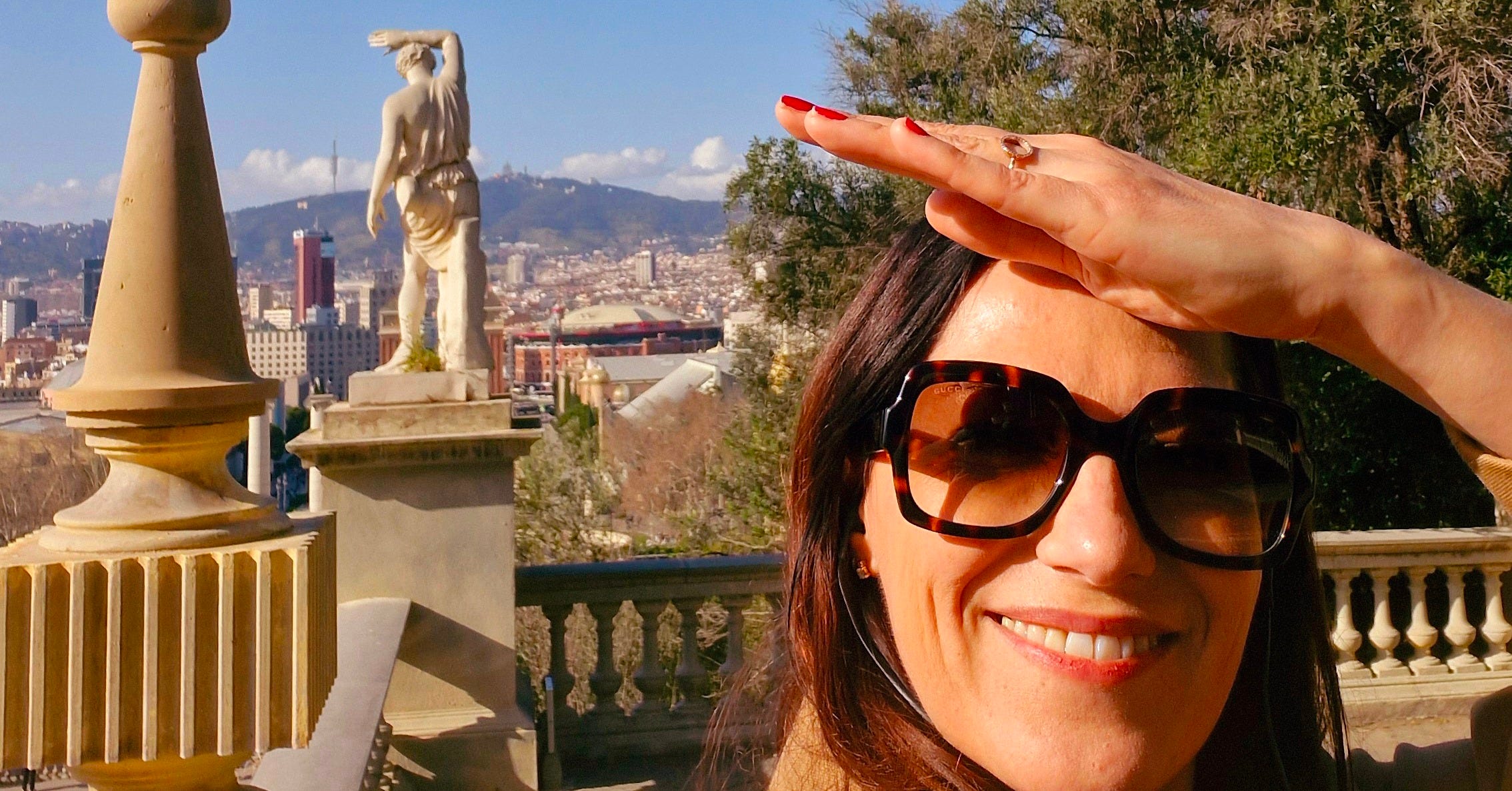
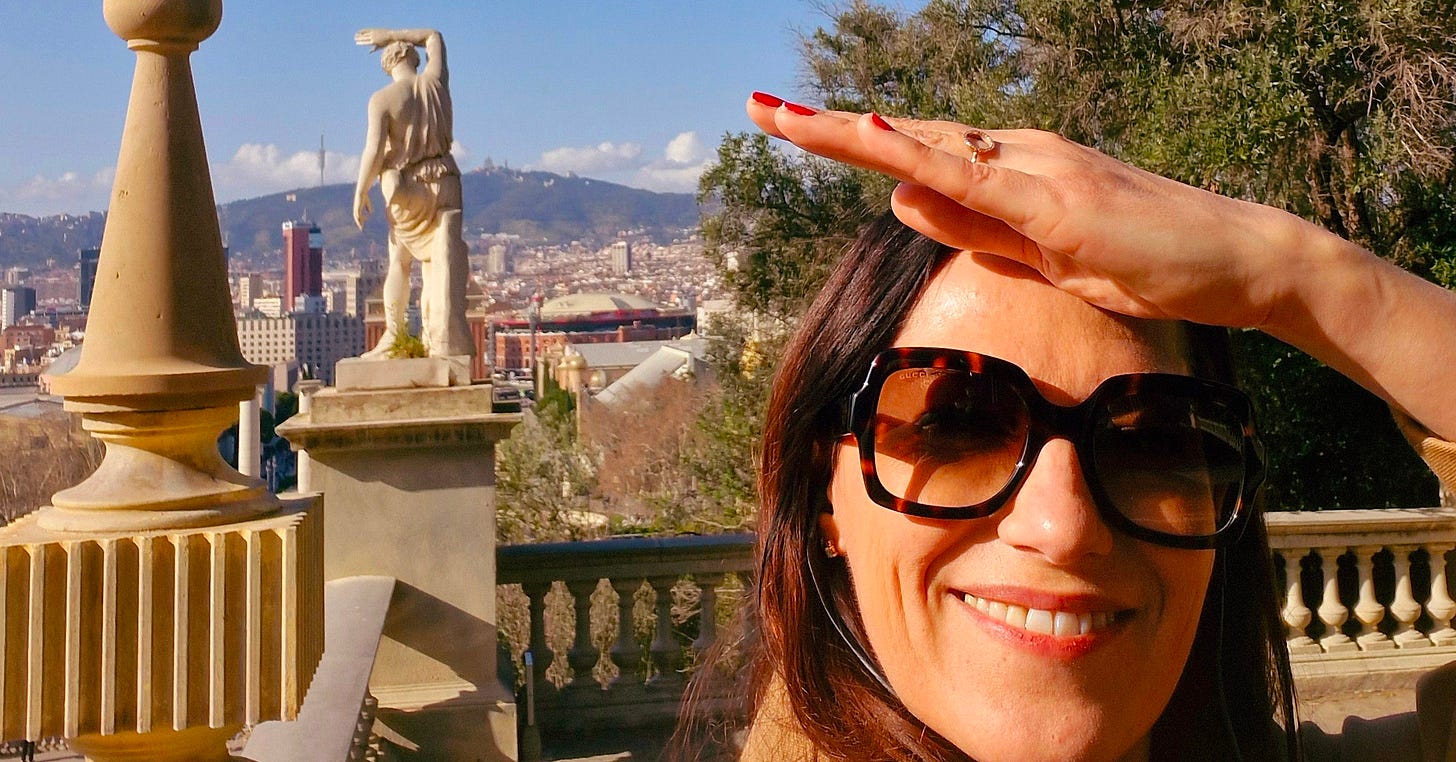
Whenever possible, I gift myself a few hours to explore or rediscover the places I travel to, and this week, I spent one short afternoon admiring Plaça d’Espanya and taking in cityscapes from the belvedere of the Museu Nacional d'Art de Catalunya. I climbed majestic flights of stairs, admired the fountain, and dodged tourists crafting all sorts of scenarios for social media. I then made my way to the town center to admire one of Gaudí’s classics—the exterior of Casa Batlló, a UNESCO World Heritage icon that welcomes one million visitors every year. Unfortunately, I arrived too late to go inside.
However, last year, I had the chance to visit two other highlights of Catalan Modernism, one so exquisite, lyrical, and powerful that it took my breath away and brought tears to my eyes—the sumptuous Palau de la Música Catalana, designed by Lluís Domènech i Montaner, also a World Heritage Site. Stepping into the auditorium was an experience I’ll treasure forever—a moment of true presence that filled me with pure joy. Thinking about it as I write this gives me goosebumps. The staggering stained-glass dome, the delicate sculpted figures and intricate floral motifs, the pastel tones—UNESCO itself describes the work as a “manifestation of human creative genius.” Absolutely agree. It is pure awe, distilled.
Also worth a visit is Casa Vicens, Gaudí’s first house, with its quirky shapes, intricate mosaics, and an atmosphere of uterine warmth, gentle playfulness, and muffled sounds.
In a world constantly nudging us toward the virtual, beauty anchors us to the real and the now.
Straight Out of a Wes Anderson Movie: The Pen Y Gwryd Hotel, Snowdonia National Park, Wales
This review is long overdue. Last Christmas, my family and I spent a few nights in one of the most wonderful places in Snowdonia National Park, Wales—a place my Welsh husband had been raving about since experiencing it on a climbing trip: the Pen Y Gwryd Hotel, a classic mountaineers’ retreat where Hillary and Tenzing trained before conquering Mount Everest.
The Pen Y Gwryd is one of the most extraordinary hotels I have ever stayed in. Everything about it was quirky, weird, and unique—like something out of a Wes Anderson movie—but firmly rooted in the pure British tradition of… maintaining traditions and cultivating eccentricity.
It was here, in 1953, that the British Everest team trained before heading to the Himalayas, and the hotel’s cozy, firelit, wood-paneled, thick-carpeted rooms are adorned with memorabilia from that time. Climbing boots hang from the ceiling, black-and-white photos cover every wall, and the battered enamel mug Sir Edmund Hillary drank tea from after his climb sits behind the bar. Children under 10 who climb Snowdon are even allowed to drink from it as a reward.
There are no locks on the doors, and the bathrooms are communal (I spent an hour basking in their gorgeous, huge, original Victorian bath/shower to warm up after an aborted walk to the top of Snowdon due to atrocious weather). At 7:30 p.m. sharp, a gong sounds, summoning guests to the dining room for a seven-course traditional British fayre, served with silver cutlery and napkin rings—a meal made from fresh local produce, like tender lamb and seasonal vegetables, favouring a true farm-to-fork approach. Breakfast is kippers, porridge, or a full English—all marmalade and crusty toast.
We happened to stay during the hotel’s annual fancy dress competition, and the guests had gone all out in their interpretations of the ‘Signs of the Zodiac’ theme. We spent the evening deciphering charades with a group of zany strangers who return every year for the event. A one-off for us but a memorable experience.
This friendly hotel has been owned by the same family since 1947, and I hope they NEVER change anything.
Instagram is flooded with images of soulless five-star hotels in the Maldives and fancy chalets (and, yes, I indulge in that aesthetic too), but this place has my heart. And that’s my key takeaway:
We must value the ‘real’ a lot more.
See you next week,
Charlotte

Subscribe to I GO! for more serendipities, ideas, and reflections on life, travel, and connection.
Subscribe to get new posts
Peakub is a home for creators, publishers, and teams to publish, grow, and monetize their work — all in one place. We're building a fast, privacy‑respecting platform that helps you focus on your craft while Peakub handles the plumbing — from content tooling to delivery and analytics.


I GO! by Charlotte Kan




Comments